Everything had gone according to plan. A pleasant English-speaking Georgian at the train window sold me my berth, the equivalent of first class, on the train that would take me out of Tbilisi, across the border to Armenia, and ultimately deposit me in Yerevan in the early morning. The big remaining question: would I have a cabinmate? And if so, who? This is random chance, a roll of the dice and I had a sense of hope as I settled in, departure time growing near. Maybe there wouldn’t be a neighbour, maybe it’ll just be me. Alas it was not to be, but my trip was the better for it. Vasily, a talkative young programmer from Moscow who had left Russia ahead of last fall’s mobilization efforts, turned out to be a welcome traveling companion. His accented English was excellent and spiced with idioms and good filler phrases, and he happily shared his views on the current state of Russia, its recent past, and its future prospects.
He also knew the ins and outs of this train, showing an easy rapport with our provodnitsa. Our car’s conductor spoke English in loud bursts, untroubled by grammar and always with a winning grin. This came in handy, as she had earned my sympathy by the time 6:30 rolled around the next morning. It was at this hour, rumbling through the outskirts of Yerevan, that she turned the lights on and demanded the bedding back. Vasily showed me the storage compartments behind each headrest, including a towel rack, and was kind enough to buy my metro ticket (I hadn’t had the chance to get any Armenian drams yet). We parted ways with a handshake at Saratov Square near the centre of Yerevan. He had relatives coming later that day from Russia, and was clearly excited to see familiar faces and I wished him well.
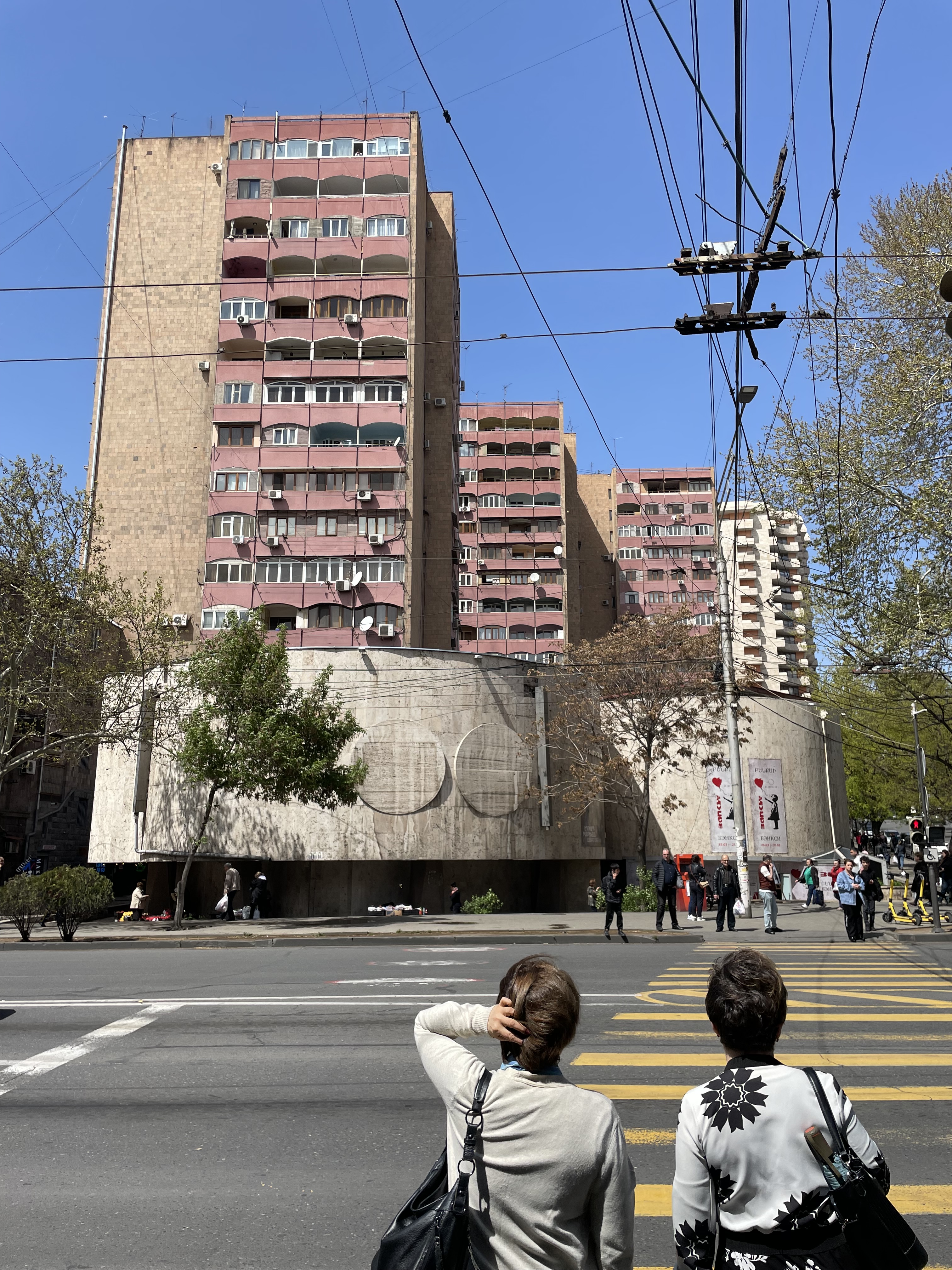
My first impression of Yerevan was muted. The train had pulled in just before 7am and the austere Soviet-era station was virtually empty, oversized for the quick discharge of passengers from Tbilisi, sterile stone and the fading echo of steps. A short metro ride took us to Republic Square, the heart of the city but again, oddly empty. The same stone looked out at the square, facing all the grandiose buildings but with few cars and almost no other people in sight. It was an odd beginning. The stone is common to Yerevan, which is nicknamed “The Pink City”, and over the next few days as I wandered the streets I saw it everywhere. It gives the city a pleasant, unifying quality. And that was the intent – the bulk of Yerevan developed in the last hundred years under the direction of a master plan for a city of grand boulevards and a crescent shaped ring road, all framing views of Mount Ararat to the west, over the Turkish border. It’s hard to overstate how much Ararat, on a clear day, simply dominates its surroundings, standing essentially alone but for one lesser neighbouring peak to its south. Armenians seem to have a deep attachment to Ararat and its name is everywhere, nursing memories of lost Western Armenia and the genocide of its people there by the Turks. A grim reminder looming over Yerevan.
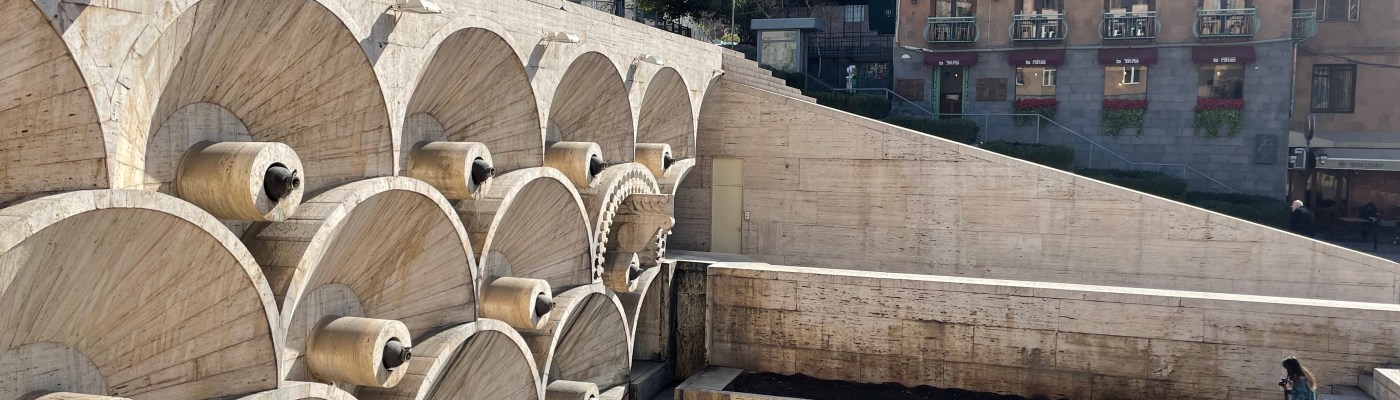
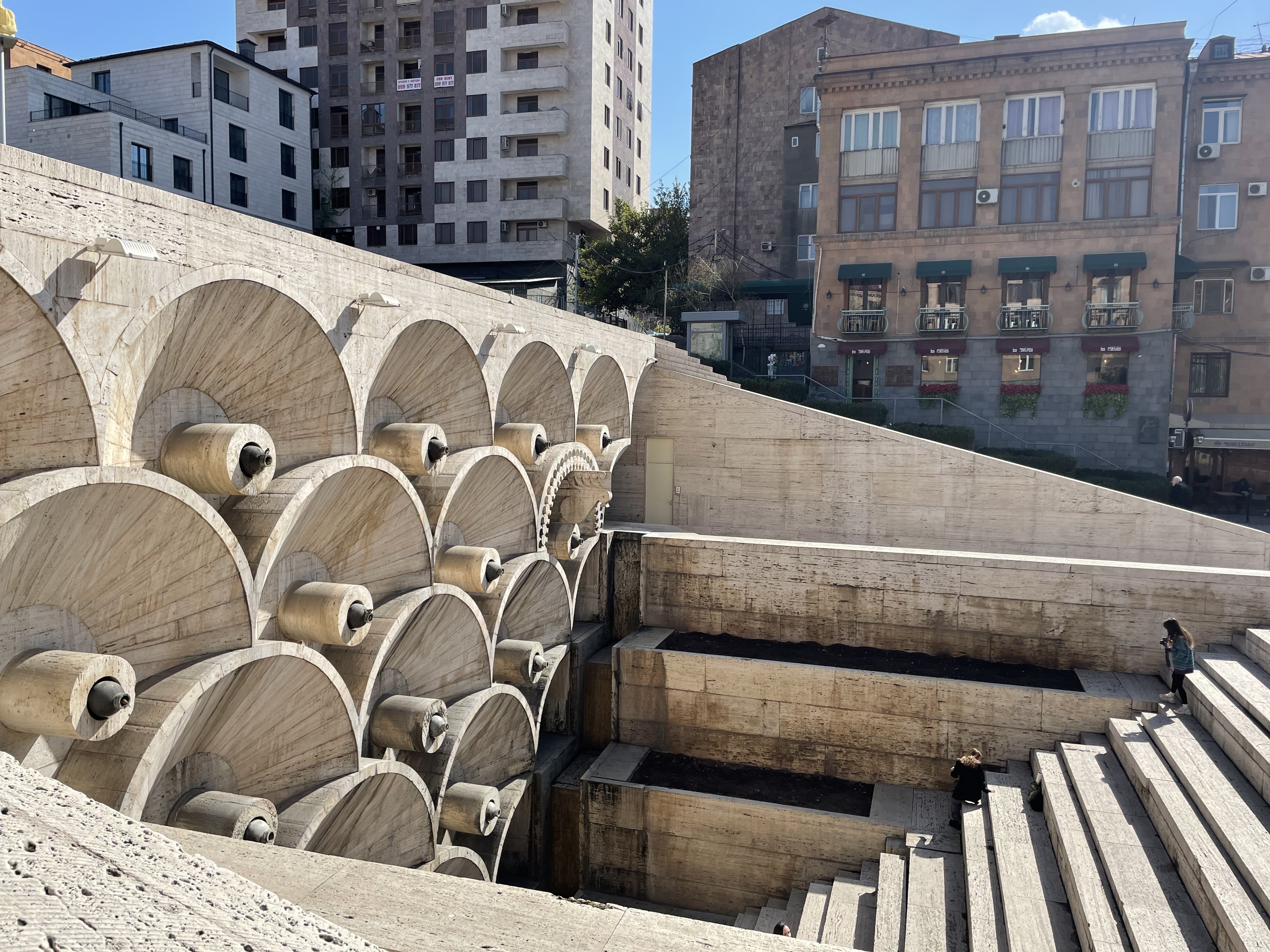
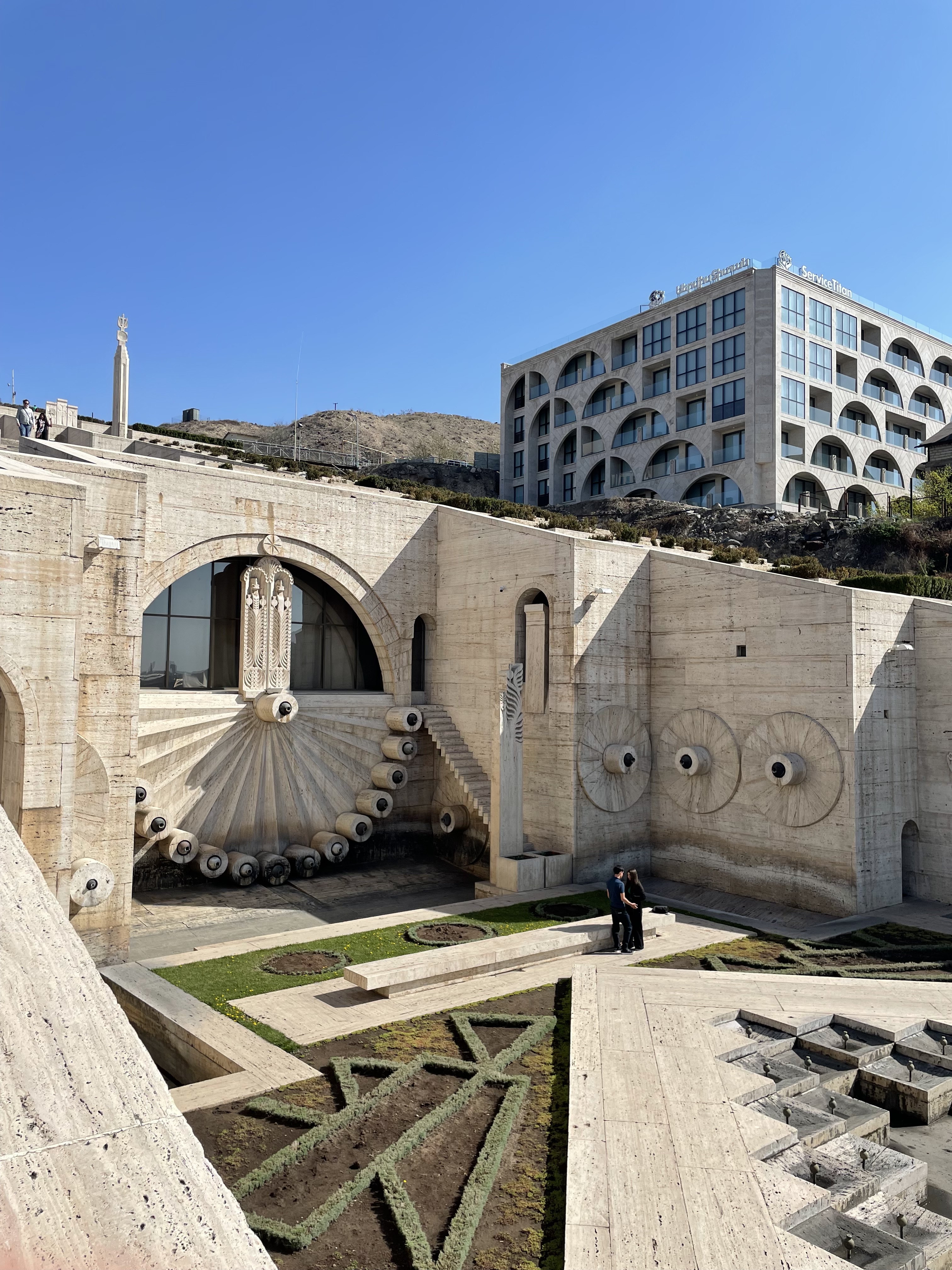
Depositing my bag and completing registration pleasantries at the hotel, I took to wandering the streets, an activity I strongly feel should be every traveler’s first act in a new place. By late morning Yerevan had roared to life, cars either racing between traffic lights or caught in inexplicable congestion. I made my way to a few spots on my list, the first being the old Soviet Chess House at the edge of the ring road. On poking my nose in the open door, I could see a teasing mosaic corner but before I could get any farther, a security guard spoke to me. While I didn’t understand him, the point was clear and I turned around. Next stop was the Cascade, and here nobody appeared to bar my entry. Begun in 1971 and completed in phases over several decades, the Cascade is an elongated vertical building and garden stepping up a hillside in Yerevan. It has the same cream-coloured stone as so much of the city, but bears a style of hard-edged geometric forms, with a few figurative elements tossed in for good measure.
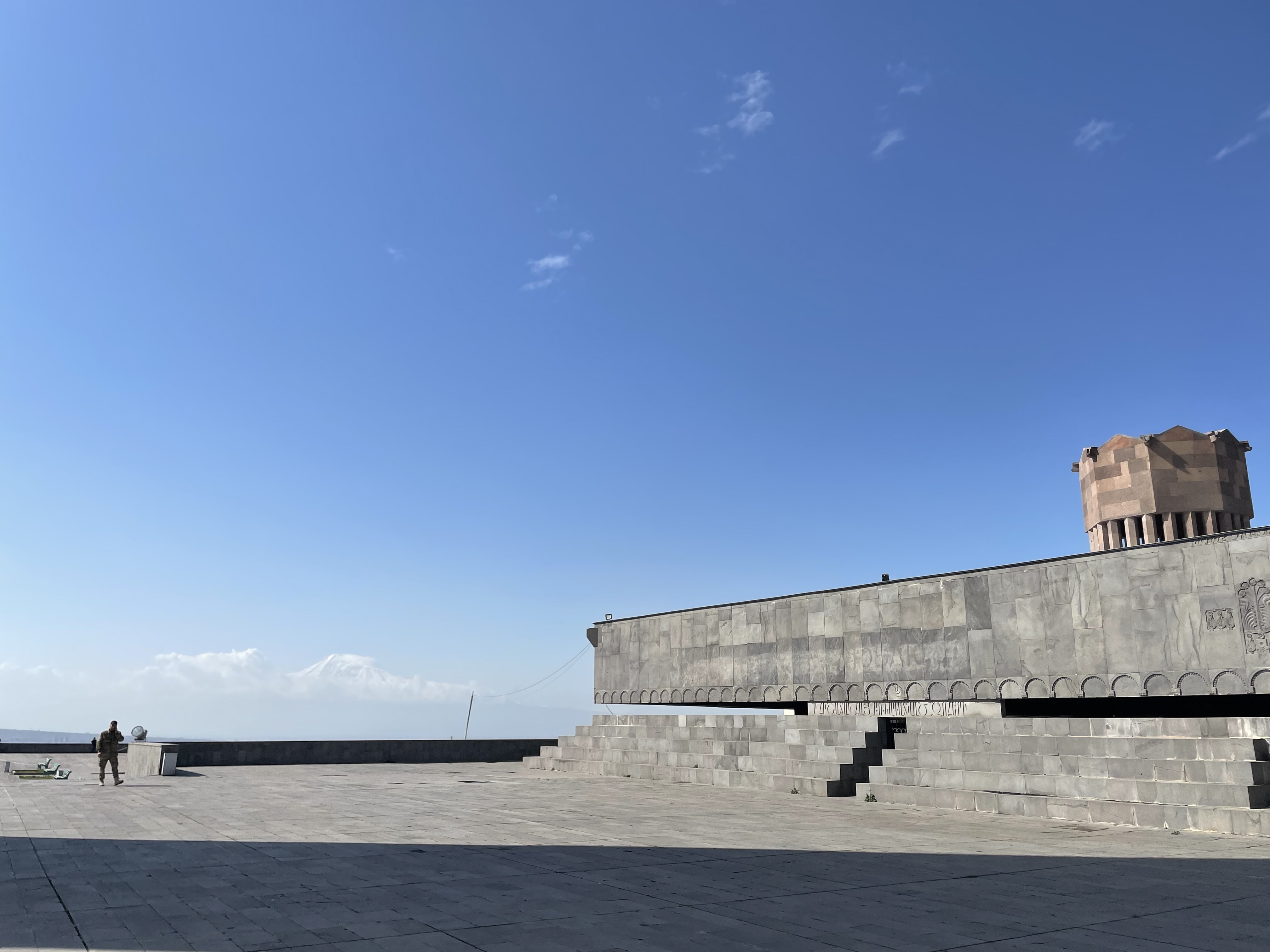
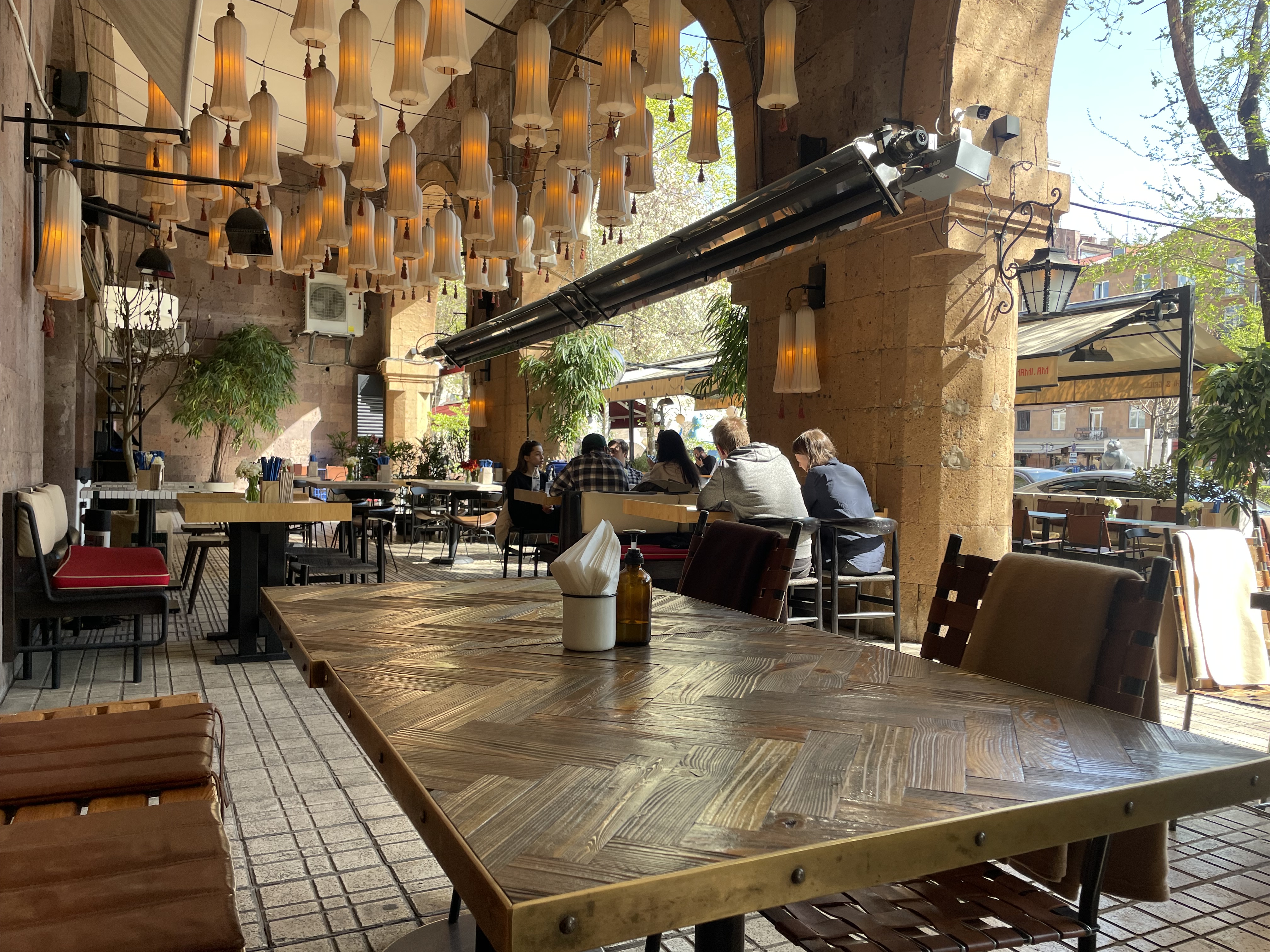
Each terrace takes you higher above the city, and evidently there are meant to be fountains which sadly are off for the time being. Nevertheless, the Cascade makes for a breathtaking centerpiece of Yerevan, blurring the line between building and public art; a climbable sculpture. Beyond the highest tier is a patch of land full of rusting rebar and broken concrete footings, the halted next and final phase of the Cascade. Farther beyond that, you can climb to a 1960s Soviet monument, all grey stone and windswept open space, celebrating the 50th anniversary of the October Revolution. The path between the two monuments is somewhat convoluted, with a clear missing piece, and I made my way back down the Cascade to a terraced café for tea and brunch while I contemplated the overt symbolism of the remaining unfinished this gap between Soviet and modern Armenia.
The other civic highlights for me were the two main art museums, the National Gallery of Armenia and the Modern Art Museum. The National Gallery was the first institution that seemed willing to take a critical stance in its exhibitions, with a contemporary examination of nudity in art amid the conservative mores of Armenian people, as well as a deep dive into an early Soviet-era illustrator. Compare this to the History Museum, which literally had dusty rocks and old pots, but no mention of the 20th century, host to events like the Armenian Genocide, Soviet conquest, World War II, and independence. The Modern Art Museum was even more curious: an independent body operating since the 1970s, housed on the ground floor of an apartment complex down an alley. Not exactly a high traffic location, and clearly a museum needing more support but one founded and continuing to take critical stances on the society around it and at risk to the artists and their supporters. I admire both the boldness and longevity of the museum. Both art museums were another reminder too of where it would be nice to have Hannah around to bounce ideas and reactions off of, preferably over a post-museum beer.
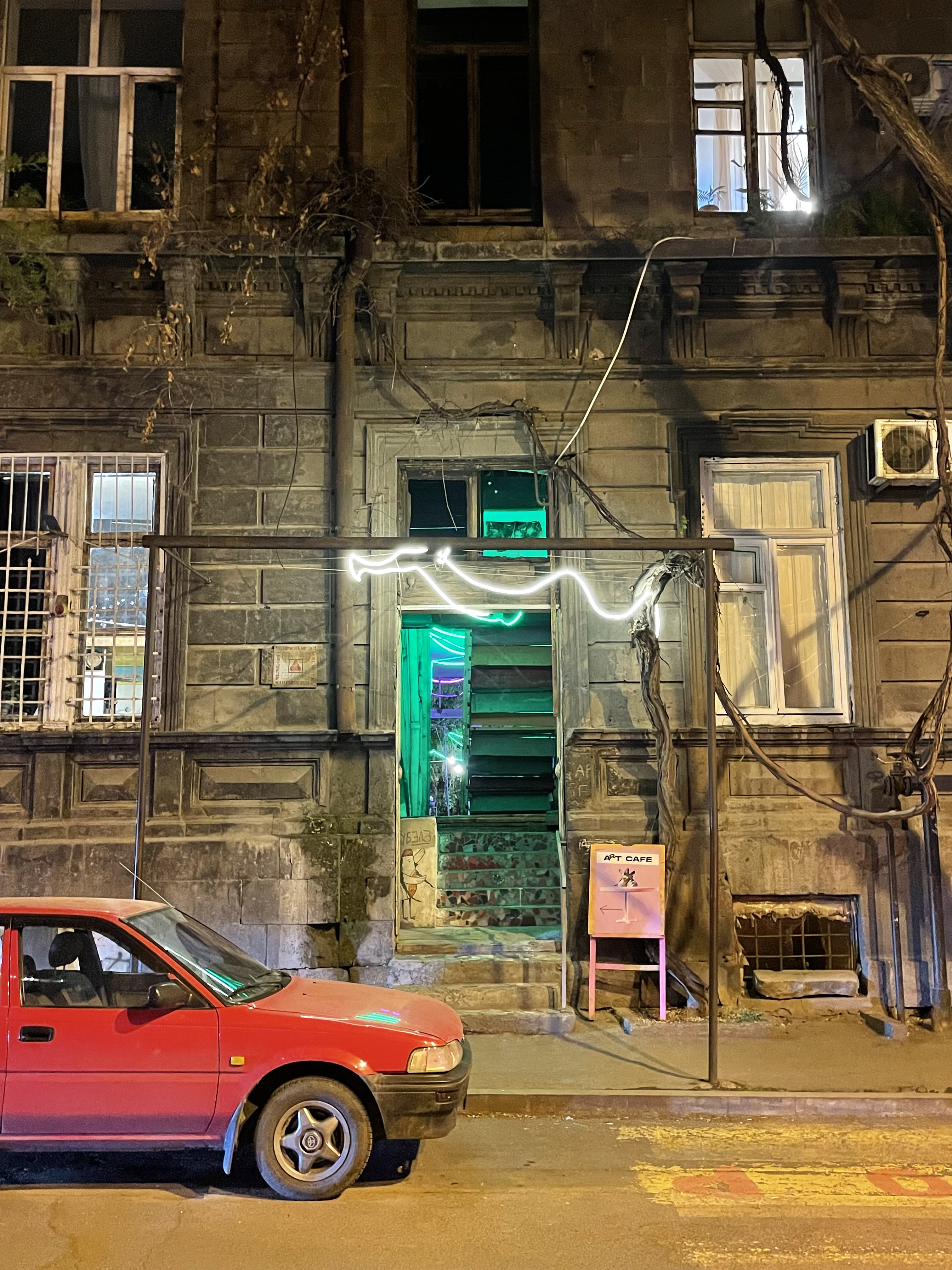
Instead I was left with the dreariness of my own company. To compensate, I went shopping. Specifically I went to the Yerevan Bazaar, which while still ornate and impressive on the outside, seems to be in the midst of a more mundane modern transformation on the inside. Imagine an Armenian Costco and you about have the idea. Opposite the bazaar is the city’s only mosque, appropriately known as the Blue Mosque for the colour of its dome and featuring a small, pleasant garden. Yerevan for me was ultimately a walking city, one where every street held promise and hummed with life late into the night at taverns, restaurants, and cafes. I did my best to lean into this, poking into antique stores and stumbling into an artist collective’s small café in a transformed courtyard around the corner from my hotel where I settled in with a book and a pot of tea.

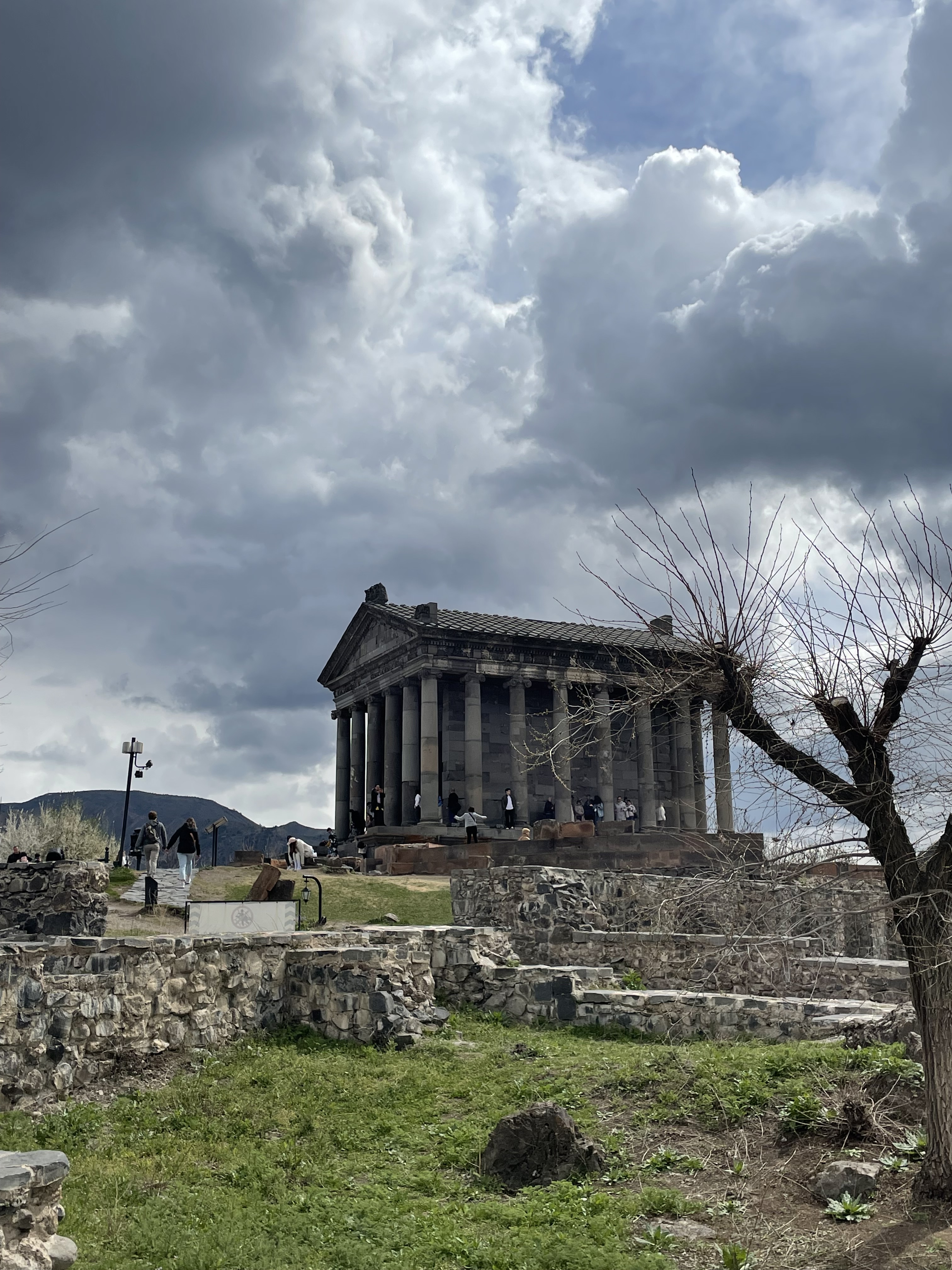
I did manage to tear myself away from Yerevan for a day, following the standard regional tourism model: fill up a sprinter van with tourists and roll from point-to-point for 8 or so hours. By now I’ve made peace with this system, its efficiency, and that it spares me figuring out all sorts of local transport in an alphabet and language I haven’t even tried to decipher. The first stop of the day was Garni, a reconstructed pagan (read: Greco-Roman) temple situated atop an outcrop over a scenic bend in the river. The site swarmed with other tour vans, everyone posing for pictures around each other and spreading their influencing magic to their social media follows. The temple’s reconstruction, carried out by the Soviets in the 1970s, was done in such a way that makes the later additions easy to discern. It’s an honest approach, but one which robs Garni of any magic.
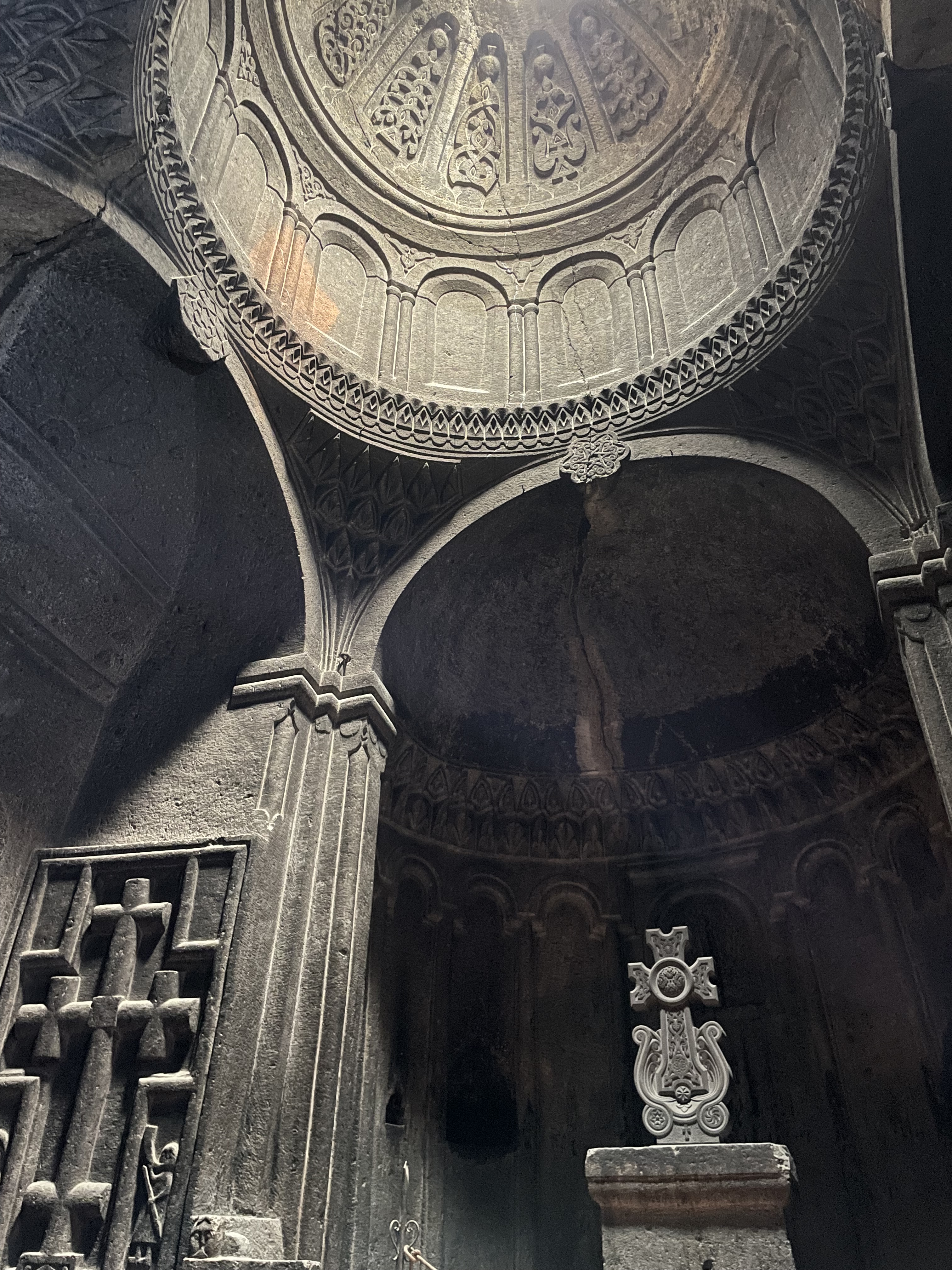
From here it was onward to Geghard, a monastery complex nestled into a valley at the literal end of the road. Here history has been kinder, and the complex largely seems to be in its original form, several dark stone churches infused with burning candles, the scent of smoke and wax offering mysticism to the solemn interiors. Portions of the churches on site were carved straight out of a single rock, a painstaking endeavour with hand tools that made the final results all the more impressive. No frescoes or mosaics cover the walls in Armenian churches, they take a more stark approach to decor, though here there were graceful reliefs sculpted into the rockfaces. One of the rooms was noted for its acoustics, which was demonstrated by a competing tour guide busting out a soft hymnal song in the space. Her voice, which was good anyway, carried through the room and everyone hushed to (mostly) appreciate the moment. Post Geghard was lunch, a long table affair at a restaurant whose overextended staff weren’t able to get the food out before it got cold. You roll the dice on these tours.
Last tour stop was Lake Sevan, and the accompanying Sevanavank church complex situated dramatically atop a peninsula. Two recurring themes have emerged in these two weeks of bouncing around the Caucasus. The first is the affection in each country for its respective national church, evidenced by seemingly every important bit of topography being crowned by a church or monastery. The second is the ongoing role of the Soviets in reshaping the landscape. Apparently the Sevanavank complex was on an island once, before lake levels were lowered by the Soviets. As an editorial, the word Soviets always seem to be shorthand for the Russians, and it is always the Soviets doing something to these countries. I’m not qualified to say if that is accurate, or if local Georgians and Armenians may have been participated more than they want to admit today. Either way, Sevanavank was a nice church, though the wind around the peninsula made me regret some of my packing decisions for the trip.

Last day in Yerevan was a language test, going to the train station to sort out my onward travel to Gyumri. The set-up here, with a big and almost deserted train hall and no line for the ticket office, was perfect. You could not script a better live-action language quiz and I was able to get sorted without much fuss for the next-day departure. The woman on the other side of the window spoke English, but I this was only revealed to me at the end and I am giving myself a passing grade. Otherwise the day was spent wandering around delightful Yerevan, taking in the Matenadaran, a museum of ancient manuscripts in an imposing black basalt building, again atop a hill. I also managed to get chided by an attendant at the City of Yerevan History Museum for taking a picture, apparently this goes against the rules. Sadly they had little worth photographing anyway, a collection of dusty artifacts in need of a narrative. You would think in a city founded before Rome that there would be a story to tell.

 Zak Abroad
You write beautifully!