
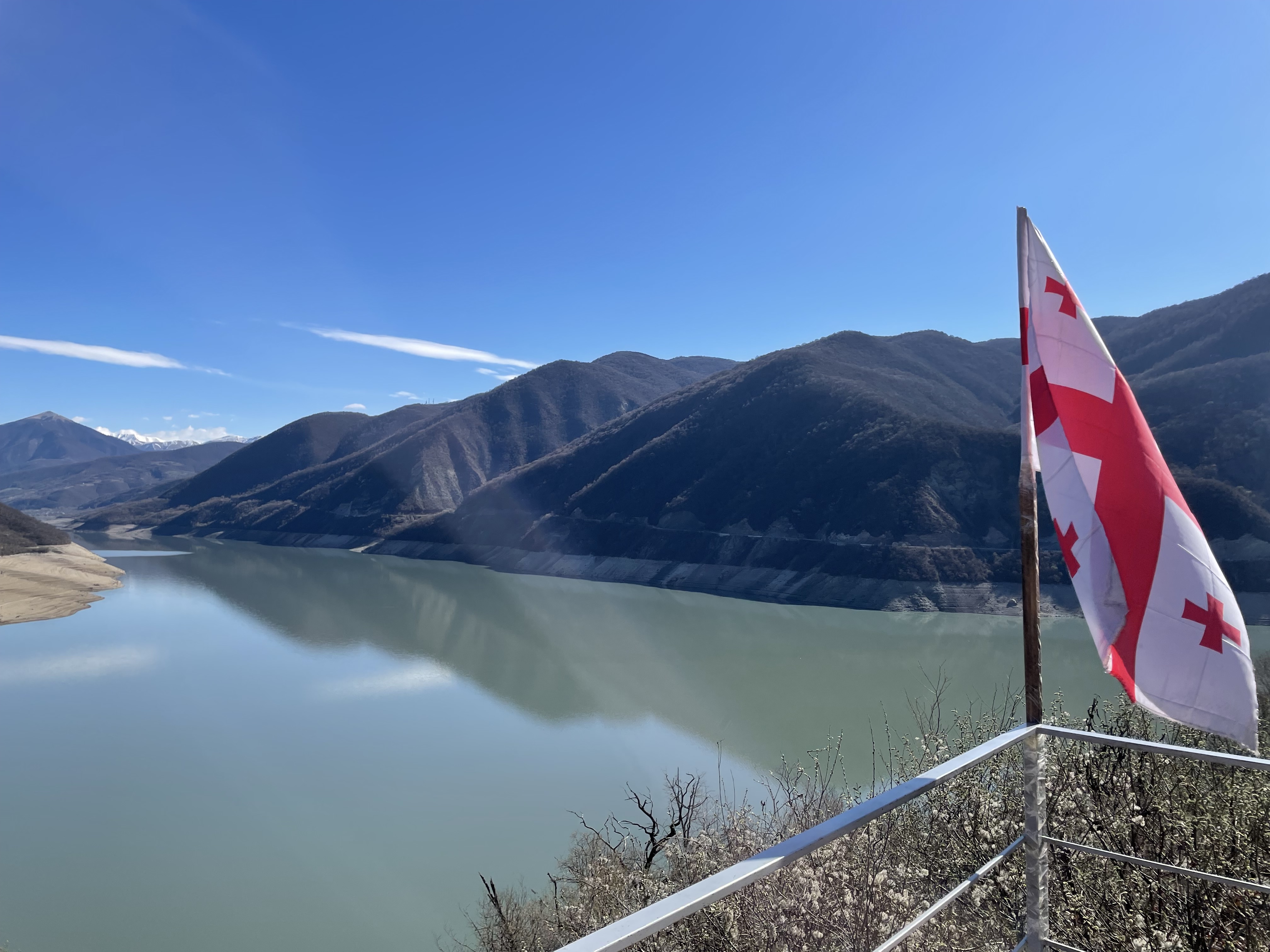
Well I broke down and took a tour. I’ve prided myself for many years on being an independent traveler, getting from point to point by taking whatever inconvenient bus is plodding along the side of the road. In the end, at least in Georgia, its too much damned work and instead of hunting down some milk run marshrytka, I found myself in a 16-seater van headed out for Kazbegi, a region high in the Caucasus mountains pressed up against the Russian border. En route we would have multiple stops, the first of which was, according to our guide George, the Zhinvali Reservoir. The stop itself is mostly a photo opportunity, with various viewing platforms set out on the shoulder of the highway, buffered by stalls of snacks and souvenirs and featuring, to everyone’s delight, a troop of puppies and their tired mother. The reservoir itself is picturesque, with the snowy tops of the Caucasus looming in the background, and is a legacy of the Soviet era, providing water, electricity and irrigation to Tbilisi and its surroundings. The price of progress in this instance was the flooding of a small village, whose residents were relocated into khrushchevkas, lowrise Soviet apartment blocks, in the town of Zhinvali. To judge from the number of tour vans stopping and the light mood of the vendors, the locals have found a way to make the most of things.
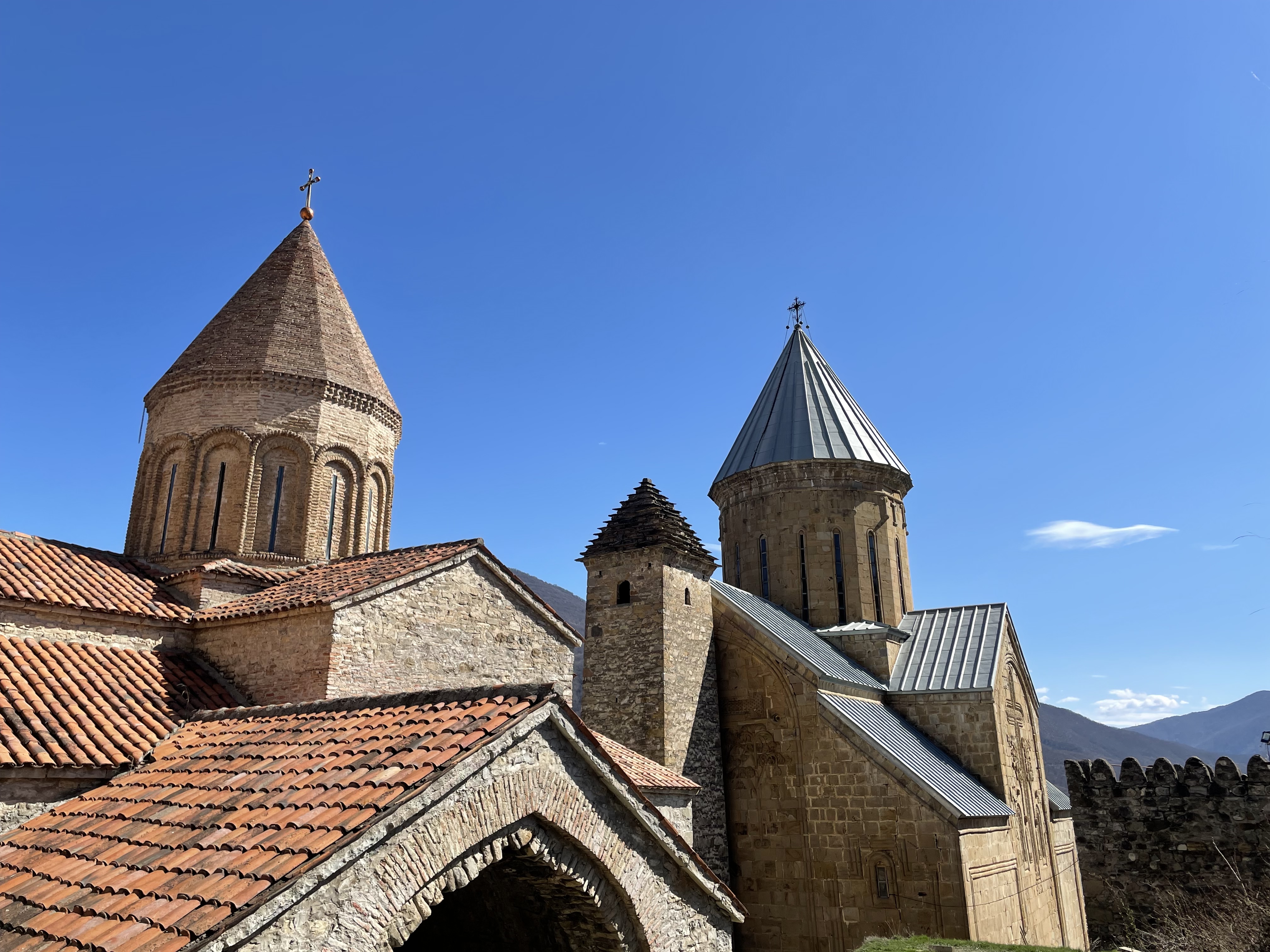
The second stop was the Ananuri fortress complex, just a short way up the highway and situated on an outcrop with a dramatic view over the reservoir. Through the course of the day it became clear that these fortress/church combos are a national past time in Georgia, and they seemingly dot the countryside at every twist or turn in the road. The architecture of Georgian churches are distinctive and become easy to recognize, typically cut from austere stones with some minimal relief carvings on the outside and their circular turret dome. Sadly many interiors, including that of Ananuri, were whitewashed by the Soviets in the effort to free people from religion. The stone reliefs on the exterior tell the tale of Christianity’s arrival to Georgia and its triumph over the previously prevailing paganism, with many churches built atop the old sites of worship, and the national identity of Georgians seems deeply entwined with the church. The walls of the fortress are traced by a narrow walkway, rising near twenty feet in parts, and with no railing in sight. It is an insurance nightmare, abounding with liability issues every step of the way.
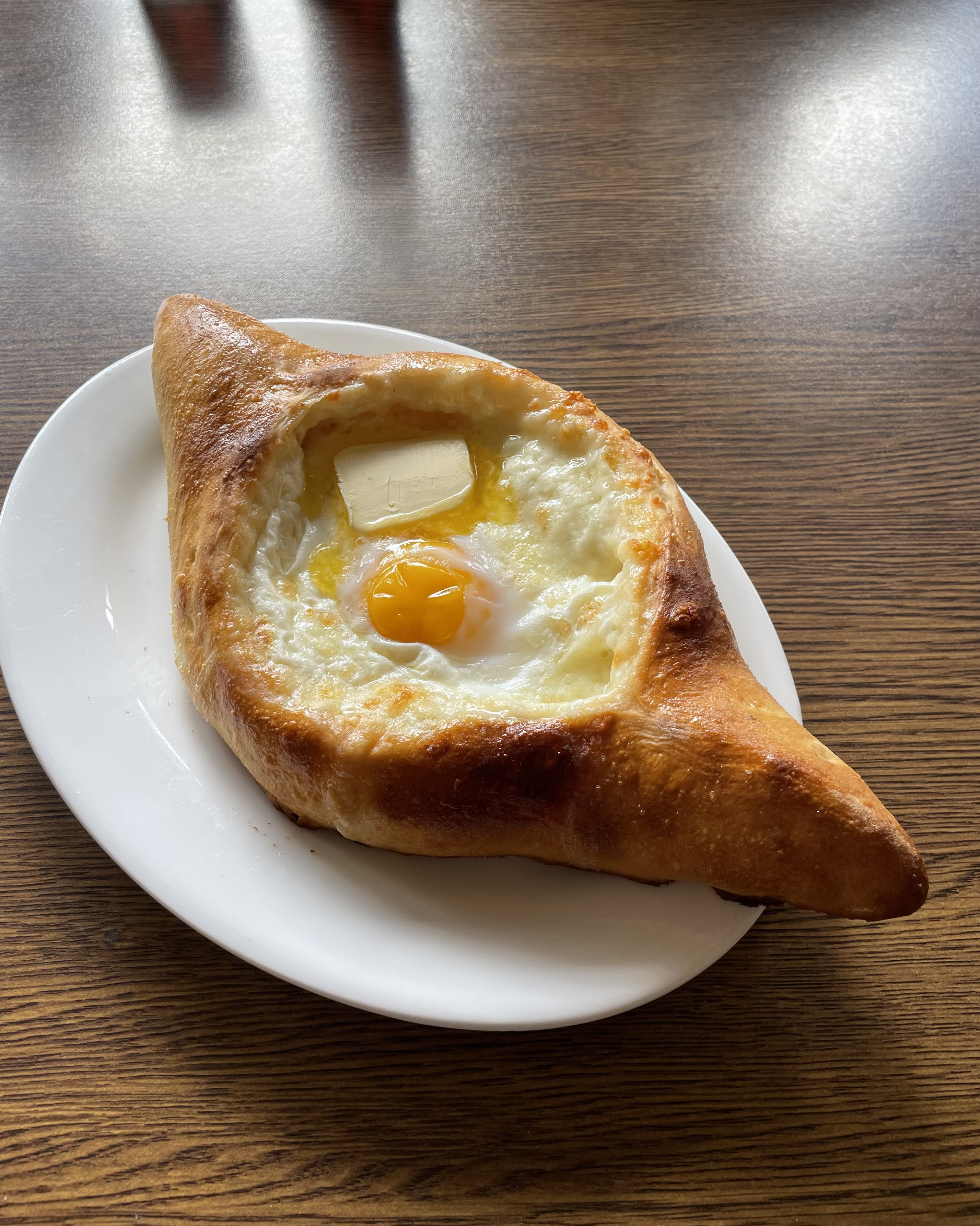
From Ananuri we stopped at a roadside restaurant next to a rushing stream for a long table lunch. Soso, our driver, puffed away on cigarettes while George our guide gave us a crash course in the art of toasting in Georgia. It is a complex ritual, with a designated toast master and a wine pourer. Literal horns are filled with wine and are to be finished with each toast. To assure this, the horns have no way to be set down without spilling, so there is no option but to drink or lose face. Thankfully this was not part of our lunchtime experience, which instead for me was a nice cold mezze of eggplant strips with a walnut paste followed by an Adjarian kachapuri. This is the go-to meal of Georgia, a breaded boat with a pile of melted cheese, slab of butter, and fried egg in the middle. It is exactly as delicious, rich, and filling as it looks.
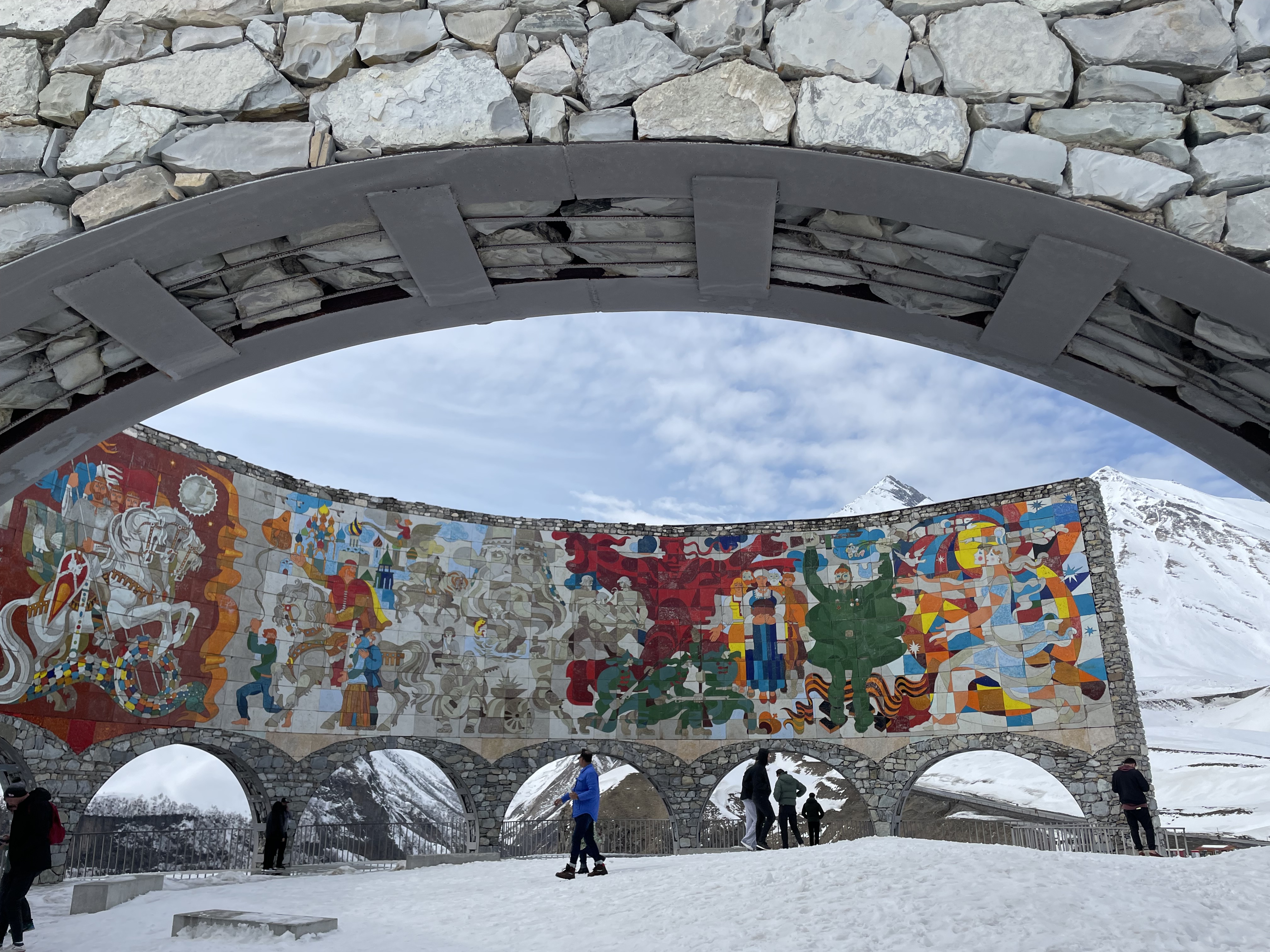
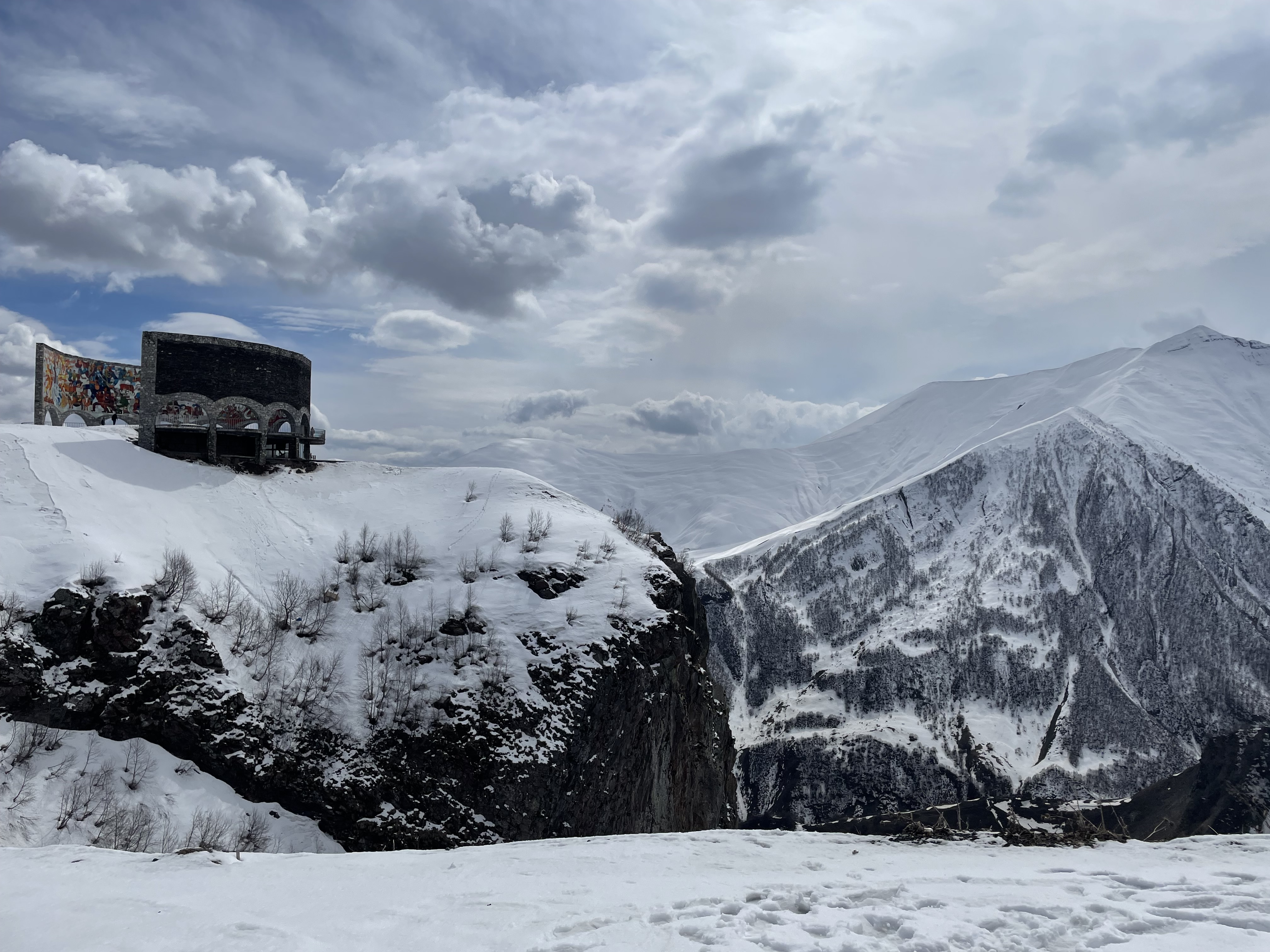
Following lunch, we digested our meals as the road hit a sharp incline and began passing through a series of increasingly high switchbacks. Along the shoulder was a line of bumper to bumper semi trucks, parked for kilometers, waiting their turn to cross over to Russia. Per George, Georgia is a key trade route between Armenia and Russia but the limited width of the roads means that waits for these drivers can stretch into weeks. Fortunately we got simply to pass the trucks, instead taking in the snow-covered heights of this border region before arriving at the Georgian-Russian Friendship Monument. Built in 1983 to celebrate the 200th anniversary of this very mountain highway, the monument is set atop an isolated outcropping, a semicircle of packed stones faced on the inside with tiles depicting folklore from the two countries. It is an incredible spot, and puts to shame competitors like South Dakota’s corn palace or southern Oregon’s ‘Mystery Spot’ through a combination of artistry and setting.
Post-monument we were off again, finally bound for our last stop: Kazbegi and its Gergeti Trinity Church. Another dozen switchbacks and we had reached the top of the highway, a pass at 2400 m (7870 ft.) elevation, and promptly came to a dead stop. With nothing but snow and rock on either side, we learned that the highway ahead was reduced to one-way traffic to allow freight to move, and it was going to be 2.5 hours before we went forward. Farther down the mountain, a new bridge and tunnel pairing is under construction and will allow freight to bypass this arduous wait, but we are unfortunately a few years early. Faced with hours of time sitting in a van, going nowhere, and a likely similar long wait coming back, the group discussed options and agreed to forgo Kazbegi. In lieu, George promised us a pair of other sights on our way back to Tbilisi, the first of which is the evolving ski resort of Gudauri, something of a Caucasian-style Whistler. Like any good ski town, prices for basics were far above what you would pay anywhere else. While I was surprised by the generally good contemporary architecture, the spatial planning of the area left much to be desired, with buildings seemingly scattered at random. After a cup of coffee and a walk through the slush, it was back to the van, down to the valley, and away from the snow.
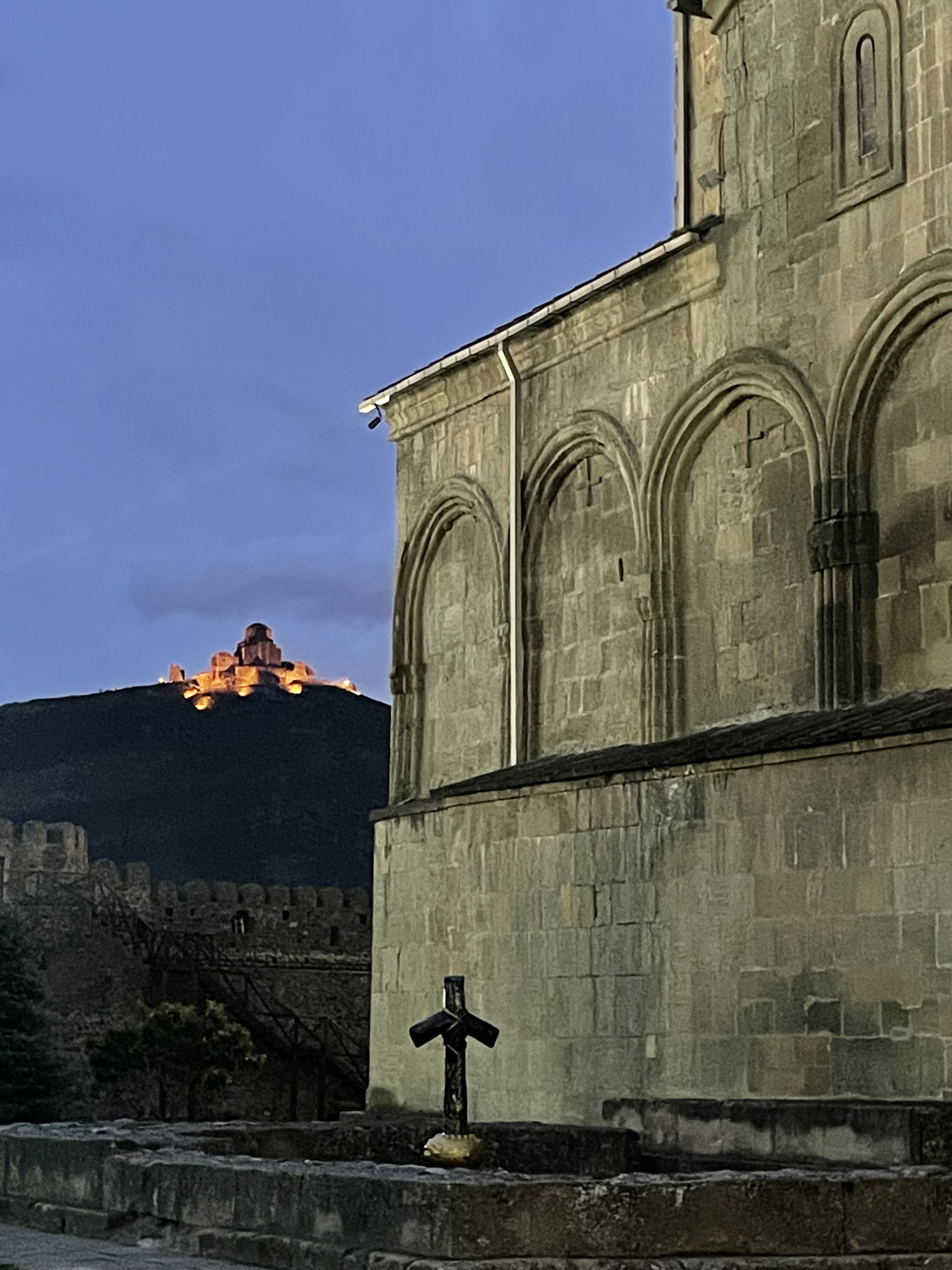
The last stop of the day was the old capital of Mtshketa, a little ways north of Tbilisi. We pulled into town and piled out of the van, winding through streets lined with stone facades before finding ourselves face to face with Svetitskhoveli Cathedral. Wandering inside, George told the group about the history of the thousand year old building, which was erected on the site where the robe of Christ is supposedly buried. The construction of the current building coincided with the golden age of Georgian history, featuring heralded Georgian heroes like King David the Builder, who assembled the empire, and Queen Tamar, who pushed the territories of Georgia to their greatest extent, circling half the Black Sea and spanning the Caucasus all the way to the Caspian. The flag from this era is the same one seen today fluttering in the wind across Georgia, the white background with the red St. George’s cross, plus four smaller red crosses. Like many an empire, Georgia was laid low by the invading Mongols, and was never again quite the same. By the time we left Mtshketa the sun was down, and an hour later we were back to Tbilisi with a long day in the books. Happy to say for all of it, the tour was the right call.
For my other day trip, I returned to my roots as a solo traveler, which meant wandering the gravel and pavement near Tbilisi’s Didube metro station until I was able to find a shared car heading to Gori, about 85 kilometers west. Beyond a quick question to figure out where I was from, and a few phone calls, our driver demonstrated a terrifying lead foot, tailgating as a tenet of faith and braking only with great irritation. It was a relief when I was dropped off at the park in the centre of Gori, outside the museum dedicated to Iosif Bessarionovich Dzhugashvili, better known to history by his adopted name: Joseph Stalin. Gori is the hometown of the 20th century’s most famed Georgian, and the middle was reconfigured in the 1950s to serve as a memorial to the dictator. The museum is a stately, formal stone structure, with a larger than life statue of Stalin awaiting visitors at the top of the grand staircase before walking you through his life and, apparently, his many acts of greatness.
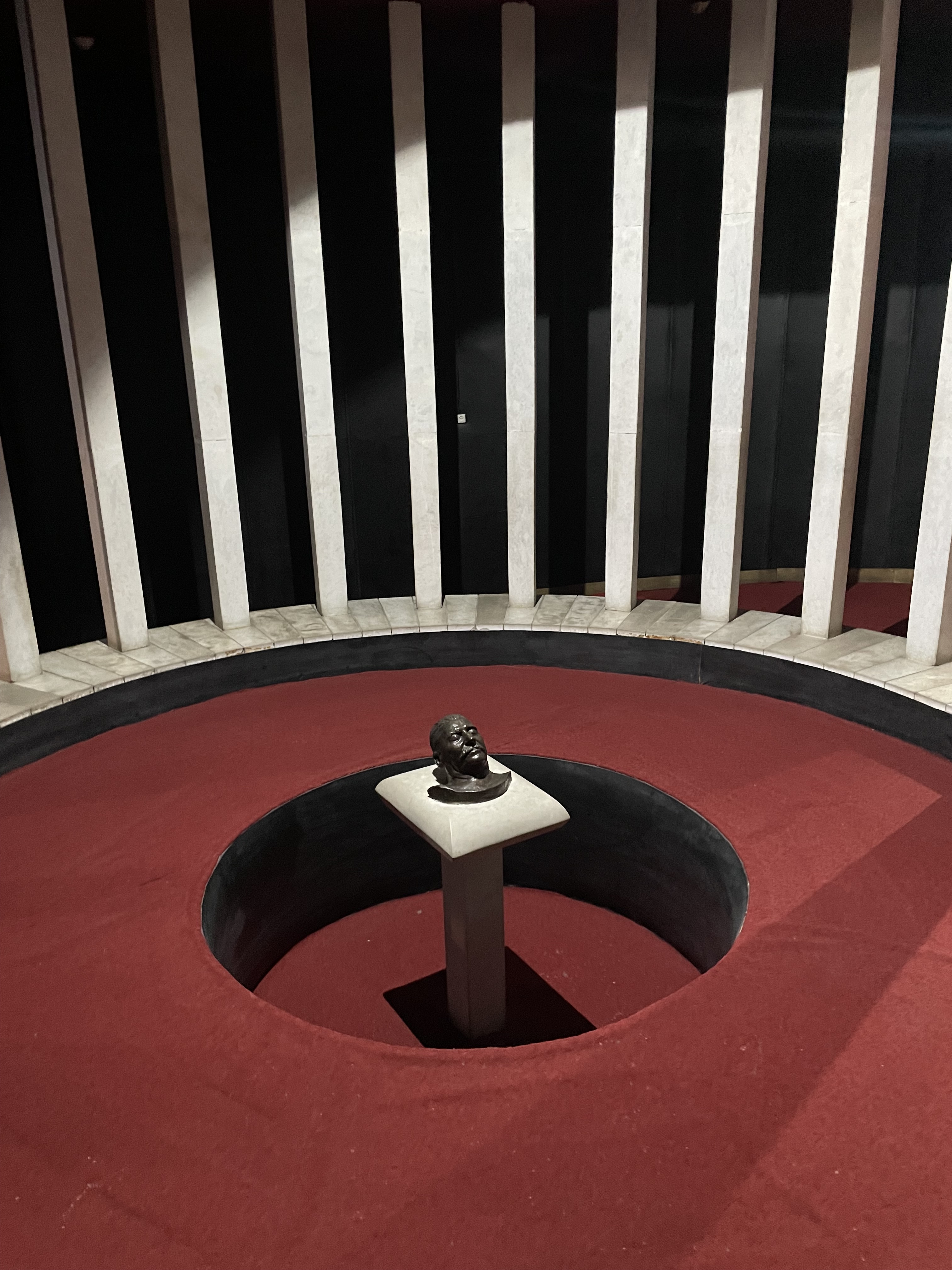
Through each well appointed room, the legend of Stalin is pieced together, from his boyhood in Gori, to his seminary years and later as a young revolutionary. His ascent to power after the death of Lenin is shown, followed by his crowning moment of leading the USSR through the Great Patriotic War against the Nazis, aka World War II. After all this, the visitor is shepherded through a solemn and spare room of black walls and red carpeting, all focused on the death mask of Stalin. Somehow after all the pomp and buildup, the death mask itself is underwhelming. In the end, the man was was as small and mortal as the rest of us. The museum, plus his childhood home outside, are the centerpieces of Gori, and seem to be the fulcrum of what tourist traffic it gets. That said, it’s harder to understand why the museum, weird time warp that it is, has been left frozen for almost 70 years. Surely Stalin’s memory can be revisited with a more critical eye to a man who, to put it mildly, made a few mistakes. At a minimum, renaming Gori’s main drag something besides Stalin Avenue seems reasonable; after all, there is rightfully no Hitlerstrasse in that dictator’s hometown.
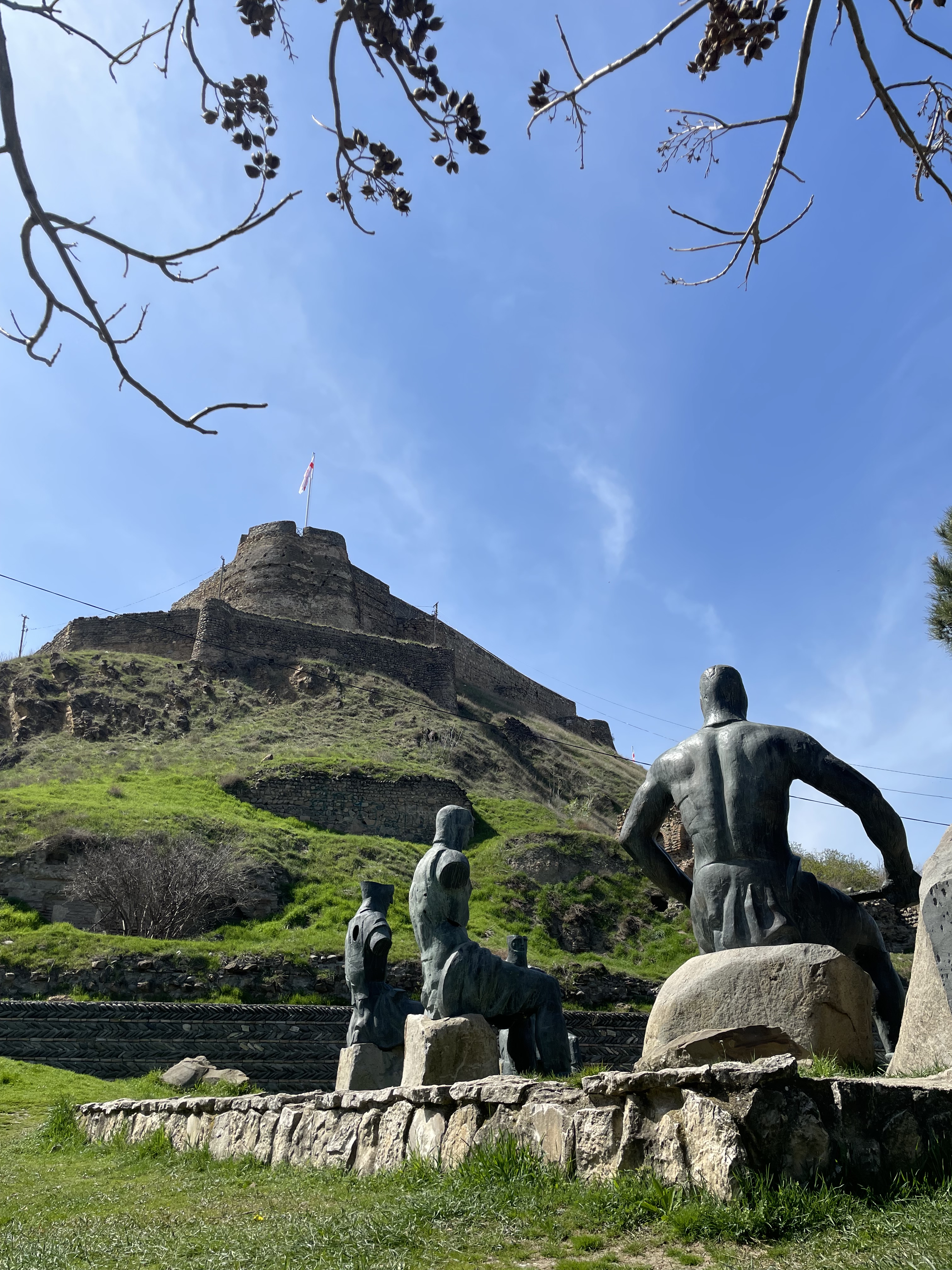
The oddity of Stalin and his museum aside, Gori is a pleasant small city. Streets and sidewalks are being rebuilt, and buildings are spruced up. The local fortress dominates area, situated atop a hill that is a short, steep climb with a welcoming breeze and views over the town. More interesting still are the old Soviet memorials at the trailheads, including one of Georgian heroes seated in a circle, limbs or parts of bodies missing, but whether through design or neglect wasn’t quite clear. Either way, one statue provided cover for a young couple embracing on the grass behind it, and I decided instead to move on to the last place on my list, the Great Patriotic War Museum. One of the babushkas was able to step away from the lunch table to punch my ticket and turn me loose in the tired museum hall, which takes the visitor through the history of the war as it played out on the Eastern Front, a fairly large blank spot in my knowledge of the conflict. More moving is the back half, where photos display hometown soldiers, I couldn’t tell whether veterans or casualties, of every conflict since the 1940s, including the war with Afghanistan and more recently, Georgian troops in Iraq and fighting Russians. The museum sits neglected a few hundred metres from Stalin’s maintained memorial, and it seems a disservice to Gori’s homegrown troops that this small space has holes in the ceiling and stinks of rot. A short cab ride and a marshrutka later and I was back in Tbilisi, and gearing up for my next stop: Armenia.

 Zak Abroad
Love this, son. Someday let’s travel somewhere together. I’ll try to come up with some ideas!