
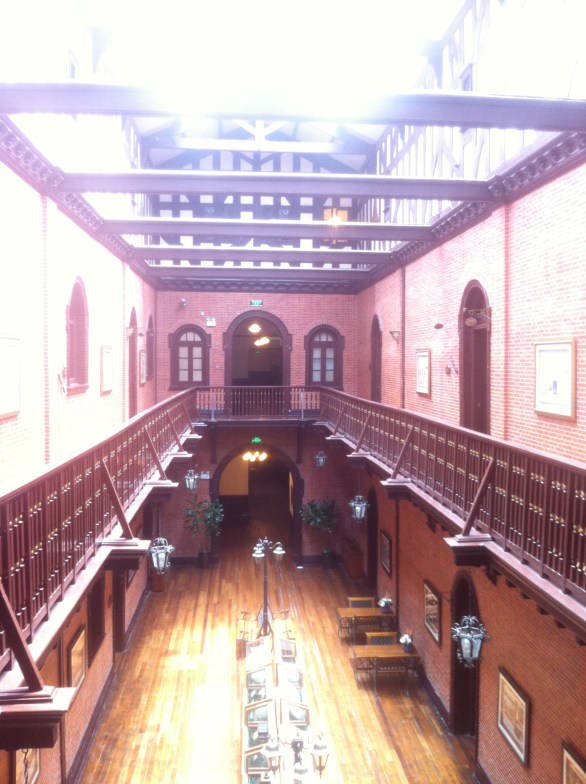
I had been to our last stop, Shanghai, a few times when I lived in China. The city had never grabbed me, seemingly just another big Chinese metropolis, though admittedly one a bit more full of itself than most. I will confess to enjoying it a lot however with Hannah, perhaps in part due to better company and having a bit more disposable income. For us, this meant great hotels with large rooms at a reasonable price. Our second home, the Astor House Hotel, faces the Bund, Shanghai’s great riverfront promenade, and dates from the mid 19th century, the first Western style hotel and host to guests like Charlie Chaplin and Zhou Enlai. An upgrade from the cramped hostels of past visits.
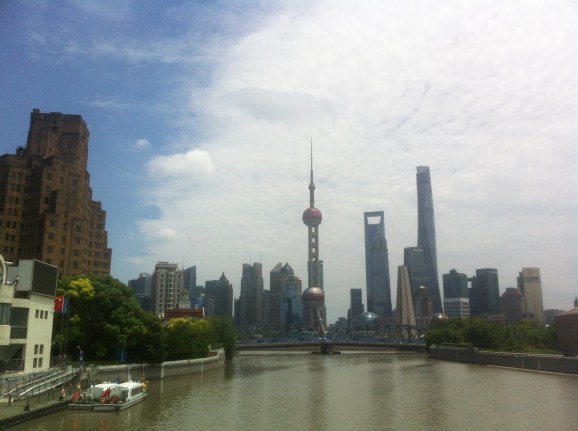
We had arrived on the bullet train from the countryside into Hongqiao, one of several teeming transport hubs in the city, before hopping the metro into town. Shanghai and Beijing constantly trade the top two spots in the world for longest subway systems, making access to both cities dramatically easier for tourists. After a late afternoon hotel nap, we struck out in the evening and I steered us to the waterfront. Hannah had never been to China and I didn’t say anything to set up the Bund. Instead, the scene unfolded naturally, the Blade Runner-esque scene of towering glass and concrete across the water from the austere and spotlight banking buildings of 1920s Shanghai, competing mythologies for the place. She joined many of the others along the waterfront, taking the scene in. The Bund may be one of the few places in the country that offers a distillation of contemporary China, a confluence of past and future, local and global, tied together through the shared experience of the country’s leading urban destination. It feels like a place where the future is happening.
Being dutiful visitors, we made our way south to the older part of Shanghai, home to Yuyuan, the old garden set amidst a rebuilt facsimile of the traditional old city. The streets here are jammed with people, nearly all tourists or businesses capitalizing on them, moving in the slow groups that characterize people when they are far from home. It was maddening. In the garden itself, we decided to turn the afternoon into an impromptu high school grad photo shooting session, competing to one-up each other with increasingly ludicrous poses while trying not to think about quite how many years had passed since high school. Instead of standing in the lines for overpriced food, we left and within a few blocks found a Muslim noodle restaurant with the usual assortment of filling, tasty meals for less than Y10.

Food was, as always, the window into the soul of China. We found a small restaurant, crammed with tiny tables and cheap plastic stools, filled with the warm, wet air of steamed bamboo baskets holding both the ubiquitous xiaolongbao as well as a Shanghai-specific delicacy I can’t recall the name of. We would return here day after day until we left, at which point I asked if Hannah had noticed the roaches. No, she said. They were small, I said. We saw no roaches at a Sichuanese restaurant in the French Concession, part of our attempts to destroy our taste buds with numbing mala peppercorns. We settled instead into a rooftop bar, enjoying the sunset and cool beers to wash out the worst of the spicy oils.

An utter highlight, and one that speaks to the value of trip planning, was a small speakeasy-style bar called Speaklow that Hannah had looked up. It is tucked behind a secret door in a nondescript shop, and I hesitantly asked the expressionless man at the counter if this was the right place, unsure if there was a password. We waited for a moment and a young woman appeared from behind the wall, beckoning us to follow her down a arched red brick hallway and up a set of stairs. The first space was a NYC-themed Prohibition bar…we passed and went up a further flight to the Japanese whiskey bar. Twenty seats and a three-man bar, where we watched the cocktail master create the drinks without a wasted movement, a drop spilled. It was mesmerizing, performance art more than mixology.

A focus of our time in Shanghai was to see some various galleries around town. The main art museum, housed near the city centre, is lackluster and disappointing. More interesting were areas on the outside of town, like M50, a converted warehouse district jammed with small galleries and businesses supporting, like a coffee shop playing David Bowie. Farther afield were found the Yuz Museum, a privately created space in a massive old industrial building near the water housing a major exhibition by American pop artist Kaws. We also found the Power Station, a soaring former…power station…converted into gallery space, offices, and studios. These trips also got us off the beaten path of neighbourhoods, seeing the more working class areas of Shanghai.
I had politely pestered Hannah to take the maglev train to the airport when we departed. It is not everyday you get the chance to ride the fastest commercial train in the world after all. For reasons that went unexplained, the train tops out at “only” 300 km/h at the time we rode it, though there are a few windows each day where it tops out at 430 km/h. The countryside and suburbs move by in a blur and despite the dated decor it made for a nice way to leave Shanghai, the city most representative of the country’s dramatic 40 year transformation. It was also nice for me to come back and revisit China with Hannah, to have the chance to show her places important to me and for me to see them too. We’ll be back.
 Zak Abroad
I trust the noodle house more due to its roaches..