The second portion of our trip in Guangxi Province began in Longsheng, the winding riverside town that operated as our main operations base. With a map drawn on a napkin and the advice that it would take 11 hours to reach the Longji Titian, some the the most famous rice terraces in China, Andrew and I set out with our newly acquired walking sticks and armed with the determination to prove the 11 hour estimate woefully wrong. The weather was an ideal mix of cool and windy with the sun above us as we meandered down the highway by foot. Needless to say, two white men walking down the highway in rural China drew some stares, but they were at least of the curious variety and gave us the chance to reconfirm our directions by constantly asking “Ping’an cun zai nar?”
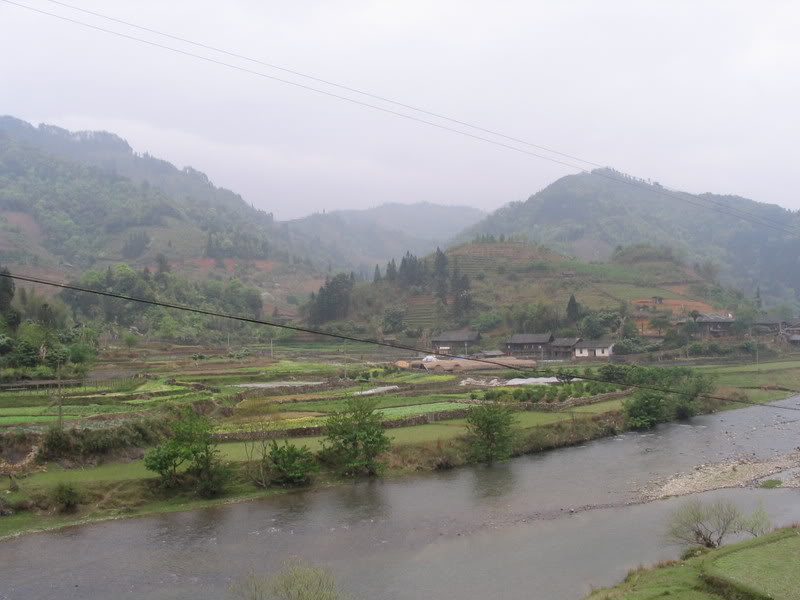
Moving down the road we passed a few tollbooths as well as some smaller minority villages set in the valleys between high, steep tree-coated hillocks. Only every couple hours did we offer ourselves a stop, to take in some mandarin oranges and replenish our energy. Eventually we found ourselves at the first checkpoint, HePing, from which we had the good fortune to run across a villager from the town we were seeking who offered us what turned out to be, accurate insight onto which dirt road we should start up. Leading away from the highway, we began a long, winding climb into the hills that led us through some gorgeous countryside with impressive vistas.
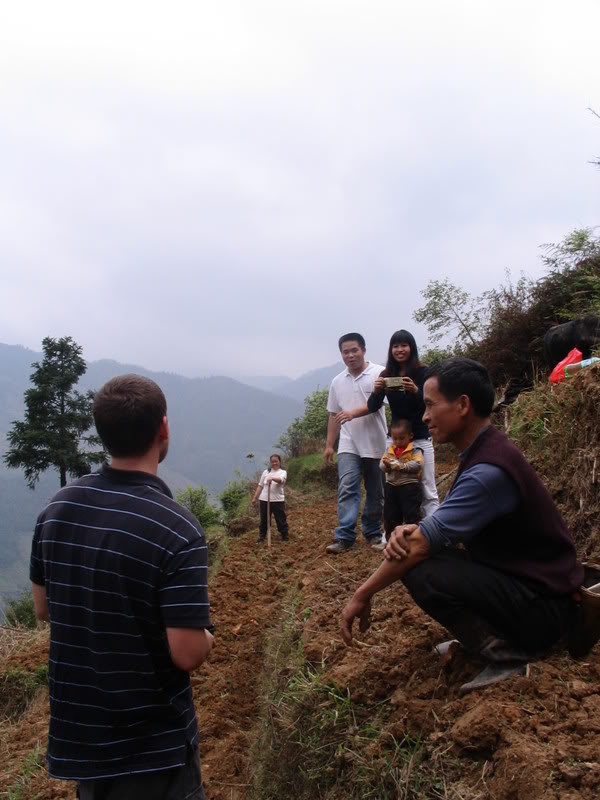
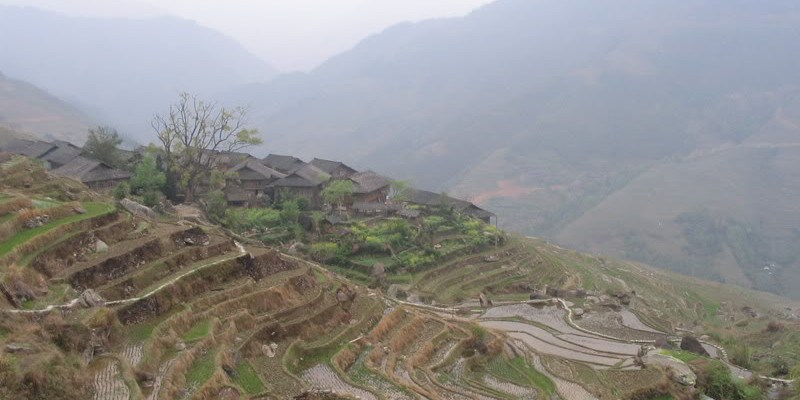
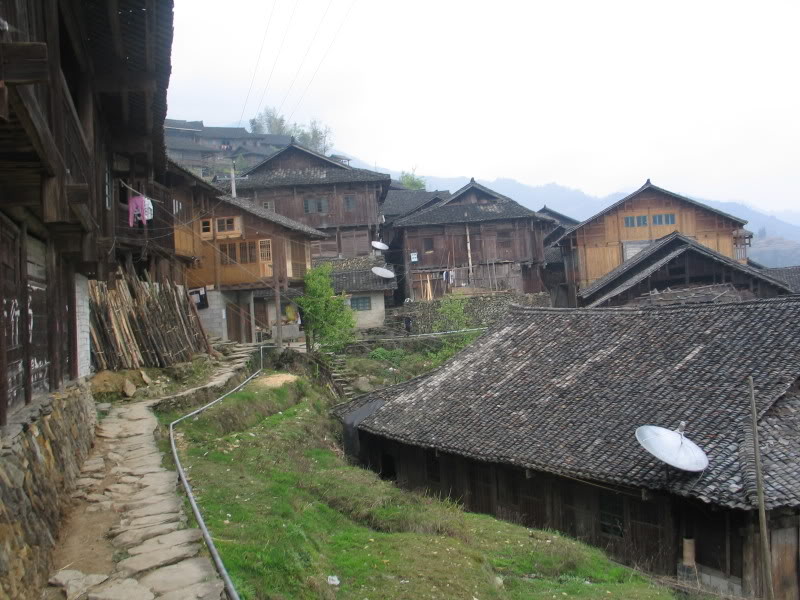
We finally drew near the village of Ping’an, a note that was confirmed to us by a break we took to try conversing with a family plowing their narrow rice paddies on the hillside. Soon we rounded the final bend, exposing the vast main expanse of Longji Titian before us and the wooden houses of the Zhuang village in the near distant. The landscape reminded me of the shire in the Lord of the Rings as we moved along the winding stone paths between the stepped agriculture plots. Eventually we got into the village and started asking around for a guesthouse. After a long half hour of walking, we found one and gratefully set our bags down and ordered a quick chao fan (fried rice) from our proprietor. Contrary to the estimated 11 hours, our hike from Longsheng took us a mere 6, and as it brought us through some of the best scenery I’ve seen in China, the effort was well worthwhile.
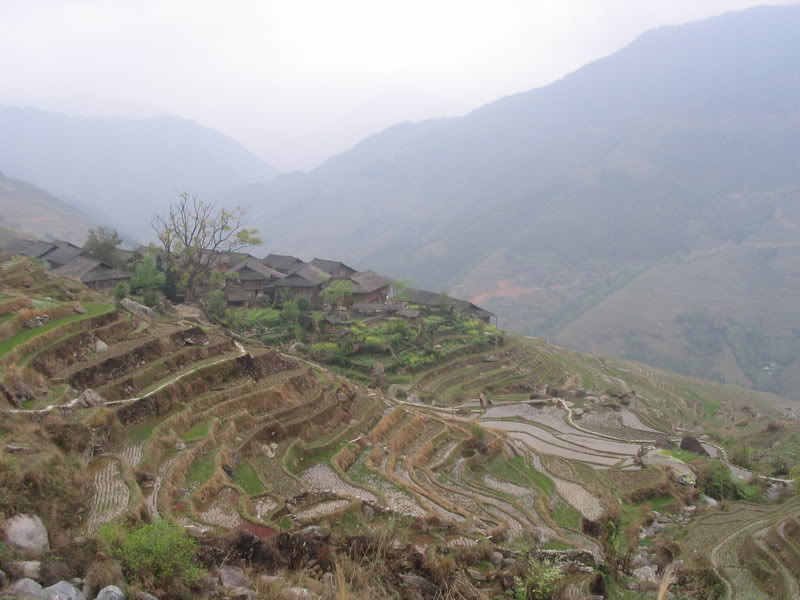
The village itself is stepped like the terraces, spilling up and down the hillside. A rousing game of ‘I spy’ conducted on a the top of a large rock ultimately led to the loss of my shoes through a critical slip into a manure/mud filled paddy. This would seem to be the lowpoint of the trip. That evening we sat in the low level of the guesthouse visiting with the husband and wife tandem who lived there. We sat with them for several hours, gorging ourselves on a feast of village food and trying to share stories while they dug out their family pictures to show us their children and old black-and-white stills from decades past in the village, all over a bout of mijiu (rice wine) poured from old soda bottles.
The next morning we set out early, intent on making it to Guilin in time to get home to Shenzhen. In talking with our hostess before our departure, we learned that we had not actually made it to Ping’an village, but were in fact in Longji village. The experience was not tainted for this fact, though it ended up proving the 11 hour prediction more than ample. It took us over an hour to hike off the hill to the highway from which we caught an increasingly crowded bus in short order. Down on the main highway, we traded up to a larger bus that offered us seats on low stools in the aisle whilst we enjoyed old Chinese music videos on the tv screen. Once in Guilin, the largest city in the area, we settled on bus tickets home to Shenzhen, as the train proved to pricey. We wandered Guilin while time ran by, and I enjoyed a pizza that I was offered not 1, but 2 forks, to dine on.

After a seemingly interminable delay of an hour and a half at the bus station, which are at best akin to depressing rundown circuses, Andrew and I managed to exchange our tickets for a later Shenzhen bus as our original never showed. We accomplished this thanks to our intrepid socializing skills (You’re going to Shenzhen?) and the kind favor afforded us by a fellow stuck traveler who exchaged our tickets along with her own. With relief we crowded into our sleeper bus and took our too-narrow, too-short mats for the long ride to Shenzhen. Waking in Shenzhen was akin to arriving in another world. I’m sure thats what the adults who leave places like Longji and Ping’an villages feel when they pour in to work in the factories as well. Overall the time in Guangxi was an excellent test of how far both mine and Andrew’s Mandarin has come, and many of the finer aspects would have been impossible without our combined linguistic might. It was also a fascinating window into the ‘other’ China, traditional and ancient, and one of my favorite experiences on the road.
 Zak Abroad
Is that a satelite dish I see on the roof of one of the village structures?