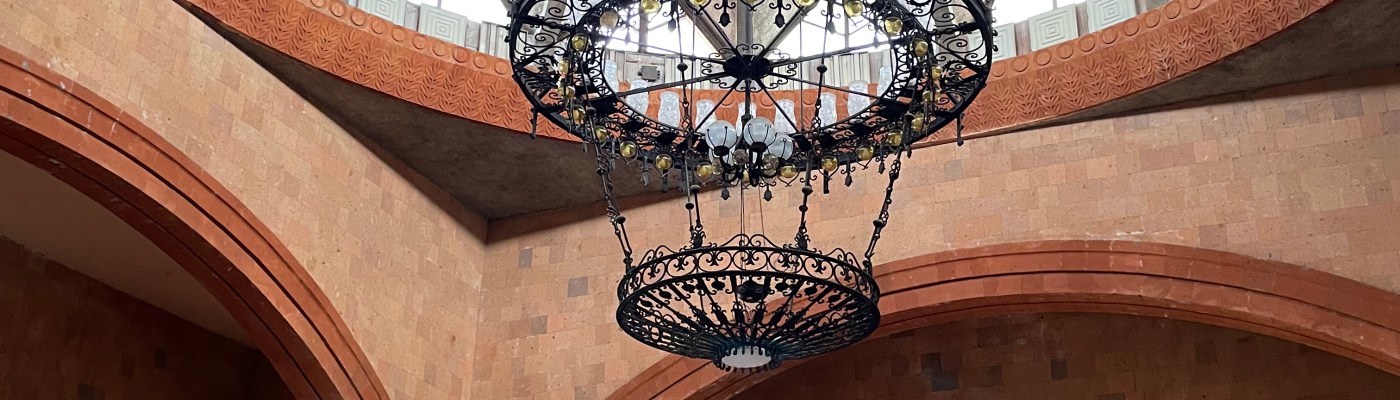
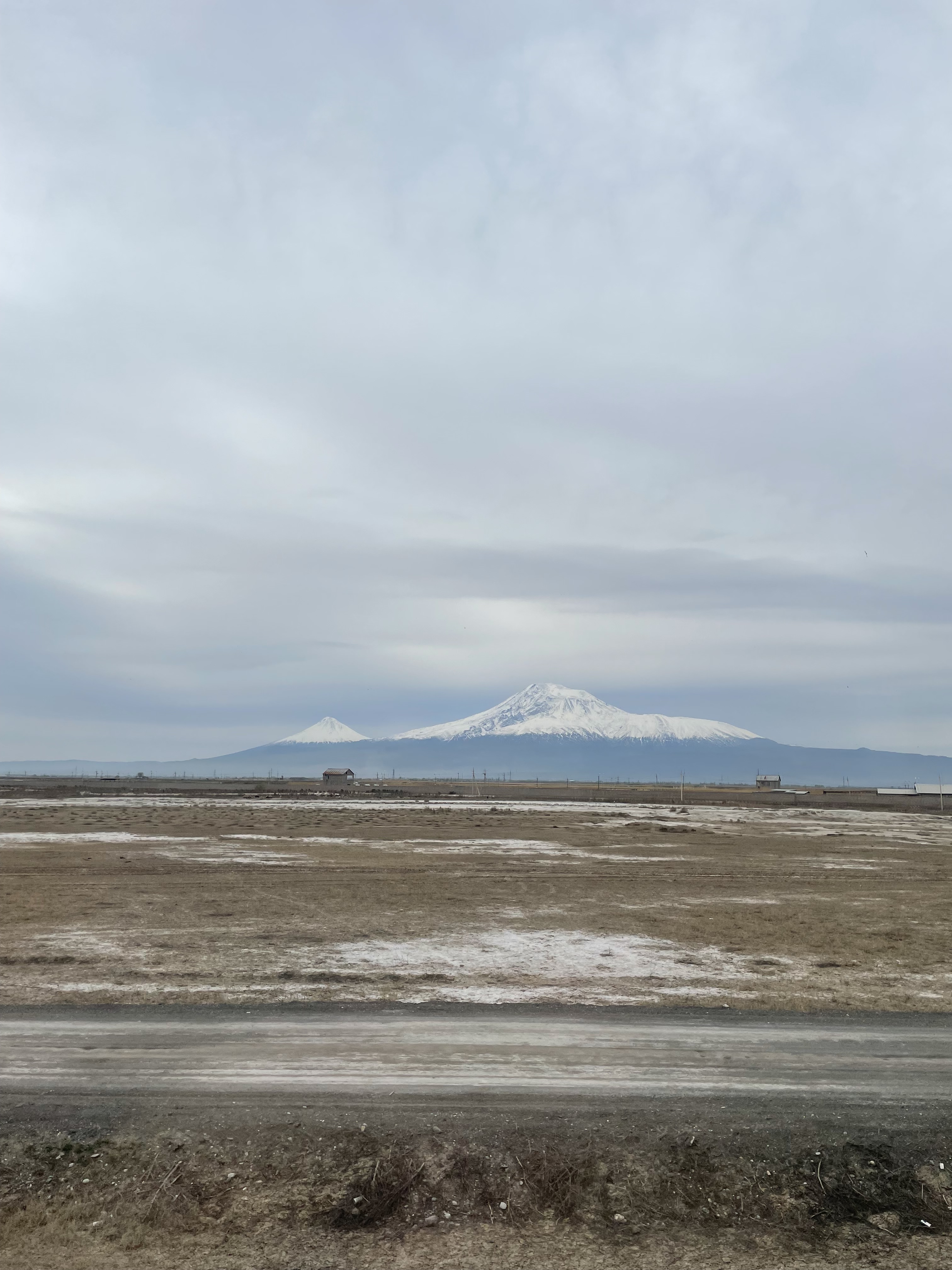
Like any activity, travel carries calculated risks. I weigh costs, time and safety against the places I go, researching in an effort to inform myself ahead of time. Ultimately though nothing can quite prepare for the experience on the ground in a new place. Here I’ve had more luck over the years than I ever deserved, so it seemed only fair that my hot streak should come to a stop over a couple damp days in Gyumri. I got into town by train from Yerevan, a short express trip on a two-car train of clean, hard seats skirting the Turkish border. We were treated to views of Ararat again, while on the opposite side a different type of monument, the Metsamor nuclear plant, flashed by. Farther beyond, as we climbed out of the plain, storks flew low over fields and past budding apricot orchards and walnut groves. Small, hard towns of broken stone houses and windowless factories passed by. The young couple opposite my seat, possibly recent university graduates, were at the stage of the relationship where they spent the entire two hours with their bodies in some type of physical contact, happily oblivious to anyone else.
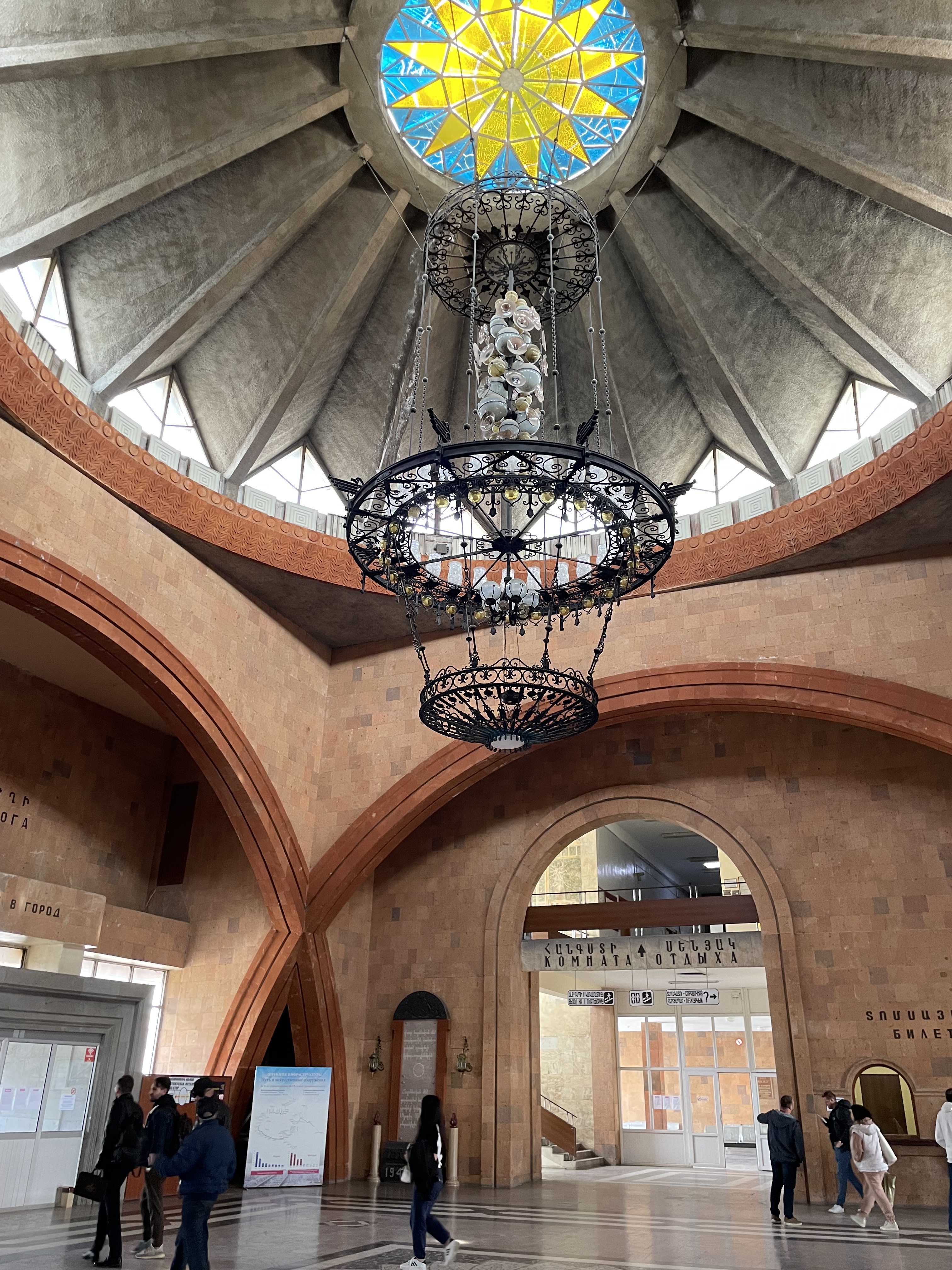
Arrival to Gyumri was a non-event, the train dropping everyone into a beautifully kept Soviet-era station. I walked from here into town, early for my check-in and untroubled by any taxi drivers who instead focused on bigger groups, their cigarettes, or both. After some back and forth messages with the owner as I tried to find the guesthouse, I made my way down a small side street where a woman, seeing me standing around looking clueless with my phone, introduced herself as the guesthouse owner. The lesson I took from this was when in doubt, be conspicuous, at least in Armenia. My guesthouse fit the literal description: a house opened to guests, with a shared living and kitchen area and individual bedrooms with locks. I had it to myself the entire time, save for a late night arrival who demonstrated the various creaks of the door and laminate boards before one got violently ill in the bathroom. In the end I never saw my fellow guests, and I suppose I can only wish them well and hope they got whatever it was out of their system.
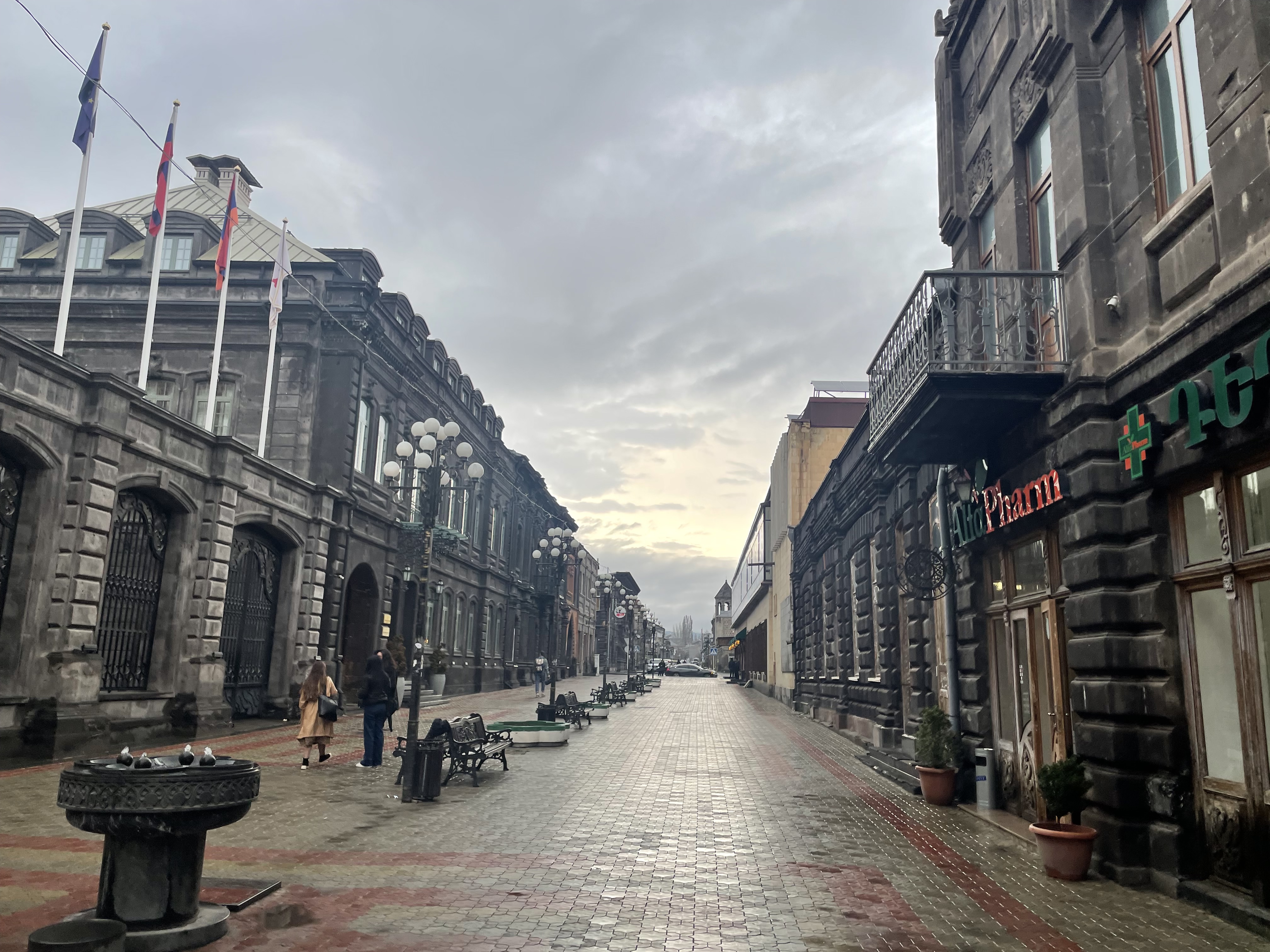
Gyumri, despite its status as the second-largest city in Armenia, has very little going on. The centre of town is a large square, encrusted with a wide ring of asphalt that is home to a slow and unending procession of cars. A few restaurants and cafes are affixed to the edges of the square, and a pair of fairly pleasant if somewhat nondescript pedestrianized streets shoot out to the north. Tired and feeling hemmed in by the afternoon rain and the underwhelming first impressions of Gyumri, I parked myself with a book at a café, ordering a beer to go with my lunch of lamajoun and ponchik. The latter, the Soviet donut, I’ve mentioned already, but lamajoun is a great snack, a spread of cheese and meat onto a warm piece of lavash bread that is, at least here, folded over on itself. Watching the traffic outside the window, I tried to guess whether there were more late-market Mercedes or well-maintained Ladas cruising the streets of Gyumri. The Lada is another USSR relic that is as ubiquitous to Armenia as a Subaru in the Pacific Northwest. The overwhelming majority of Ladas are white, bringing to mind a quote about the Model T attributed to Henry Ford: “Any colour the customer wants, as long as its black.”

There are a handful of tourist sites scattered around the square in the heart of Gyumri, including the Museum of National Architecture and Urban Life. With a grandiose name like that, I of course had to make a stop and while the building was handsome enough, the museum itself did not tell me much about architecture or urban life in Armenia. Rather, the exhibit ran like a 19th century Chamber of Commerce booth, showcasing the various industries of 1890s Alexandropol. This Russian name for the city, then part of the tsar’s empire, gave way in the Soviet era to Leninakan before settling on Gyumri post-independence. Otherwise I wandered the square blocks and low slung streets, appreciating the somber but well done black and red stone that seems to be the calling card of the town. The black stone is hands down the material of choice for the major Armenian Apostolic churches that encircle the city centre. Armenians seem, as far as I can tell, a devout bunch, and every church I poked into had adherents lighting candles or attending ceremonies. This is a major contrast to parts of Europe, where the buildings feel like relics of a bygone era. Not so in Armenia, which proudly notes itself as the first nation to adopt Christianity as its state religion around 300 AD.
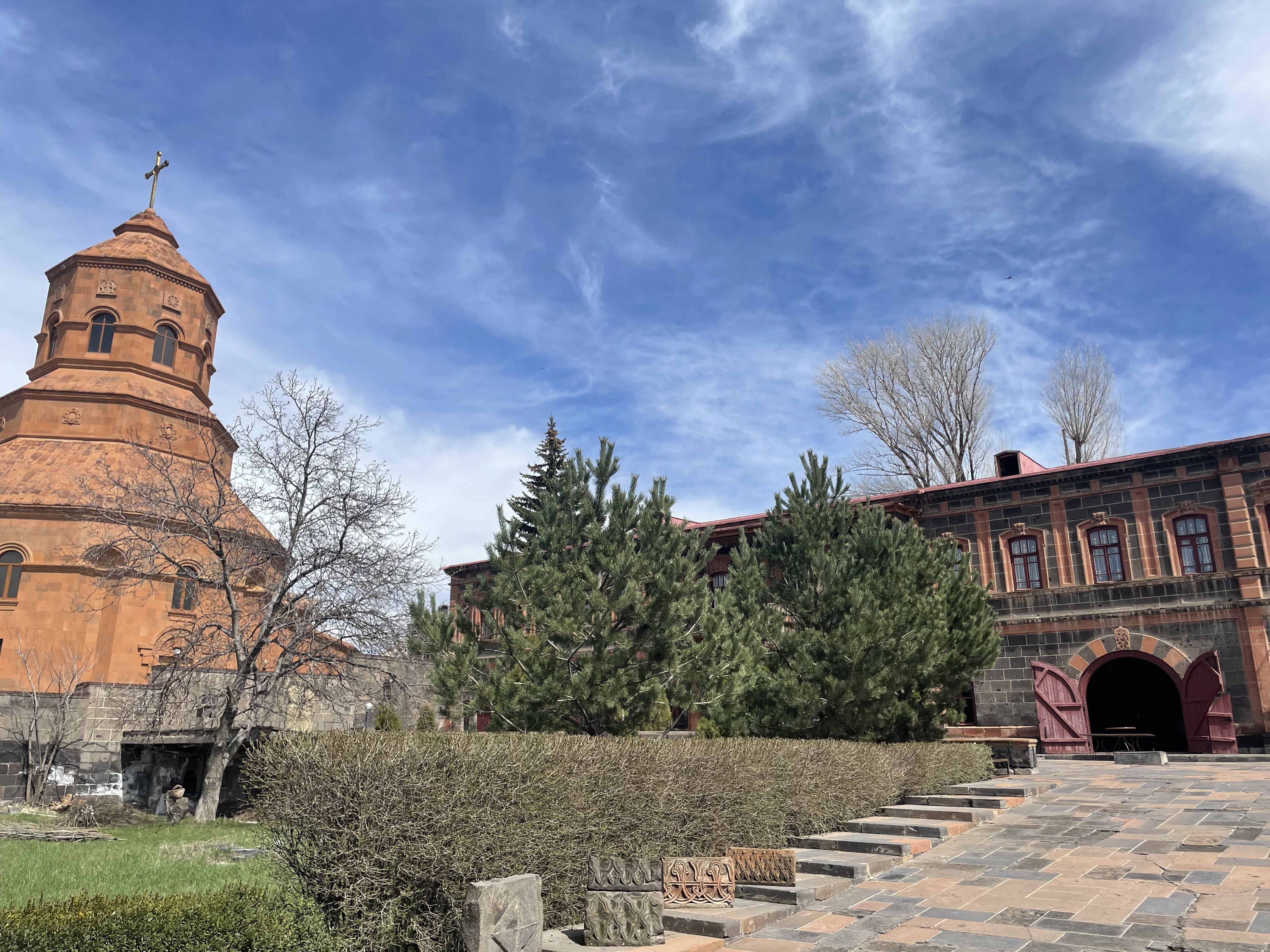
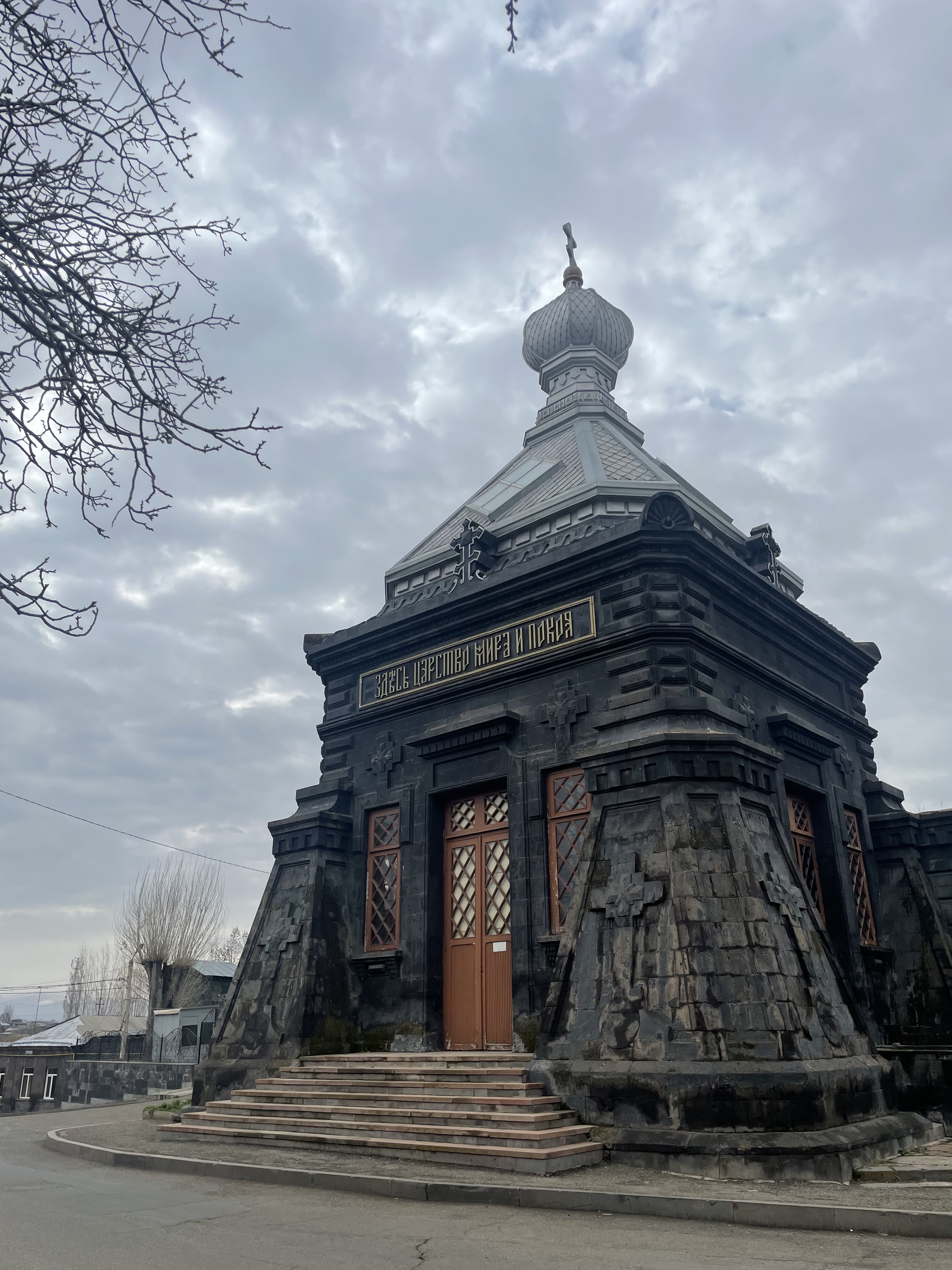
Day two was similarly overcast, with a promise of more rain and a general dampness permeating the town. I wavered between writing off the day and attacking it, weather be damned. Ultimately I leaned into the latter, passing through the town’s bazaar to see the usual mishmash of food, clothes and plastic homeware under colourful canopies. Gyumri, and the region around it, suffered a major earthquake in 1988, and the bazaar building itself seems to be a victim of this, or at least of an imitative neglect. Instead of repair, the vendors of Gyumri moved on to set up new stands around the old structure. Life has gone on. West of the market, near the city limits, is a Russian cemetery and Orthodox church. While the onion dome is recognizable, the church is built from the same black basalt as much of Gyumri, and it has an incredibly heavy, almost fortified look. The effect is further enhanced by its location, set atop a crown of land at a curve in the road – everything about it screams the desired power projection of a now-departed empire.
Farther to the west, past women sweeping the roadside with brooms and men with blank stares smoking cigarettes at sheep markets, are the last two sites on my list: the Black Fortress and Mother Armenia. The Fortress is aptly named, a low circle on a hilltop with views to (what else) Ararat and over the countryside. Perhaps as was intended, I was stymied in my attempt to gain entry to the Black Fortress, settling instead for a lap around the building. The only signs of life consisted of a dog resting in the grass near the stairs up and, flanking the other side, a guard taking a late morning nap. Even the parking lot and hot dog stand were closed.
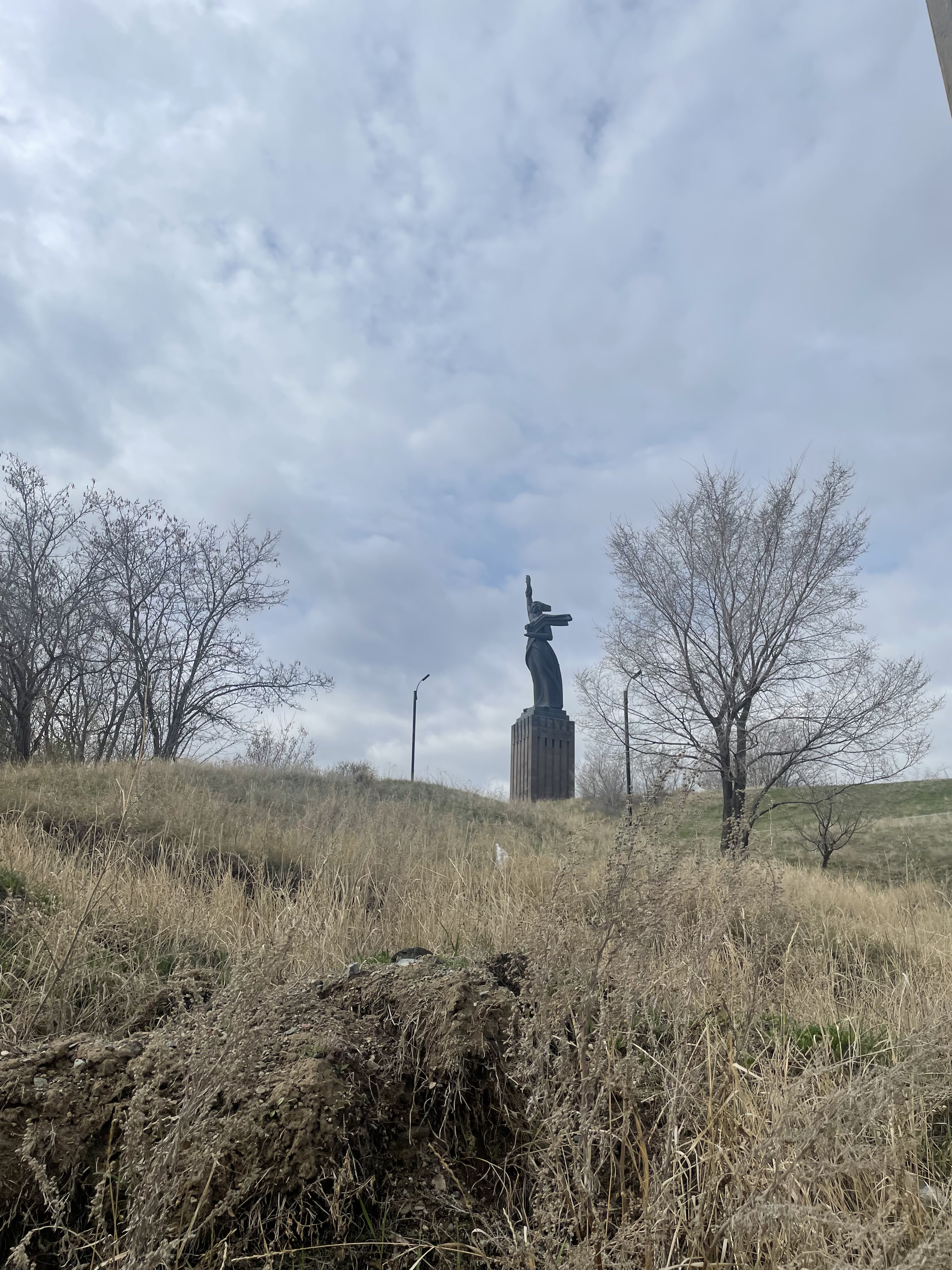
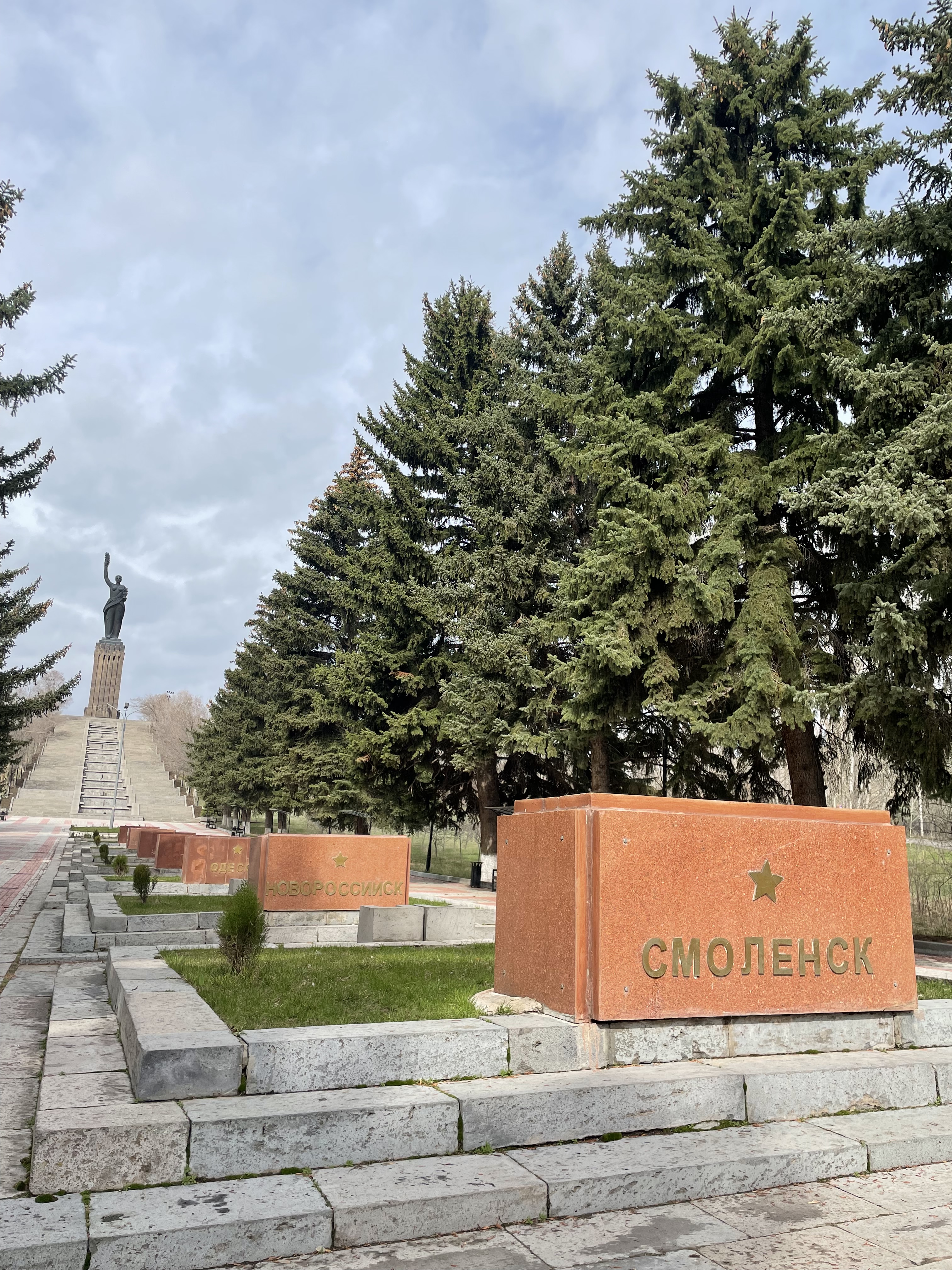
The last stop was the memorial to Mother Armenia, down and up a small hillock next to the Black Fortress. As implied, the memorial is a towering statue of Armenia herself standing upright atop a pedestal, her right hand grasping onto olive branches (my best guess) while the crown of a Corinthian column sits in her left palm. A processional staircase leads up to her, where she seems to sit forgotten. Down the stairs is a further memorial, this to the Great Patriotic War. While the Nazis never quite made their way over the mountains to the oilfields of Baku, Armenians were instead brought to the front to fight and die at an appalling rate. The Hero Cities were those who did see frontline action and in various ways distinguished themselves. Notable here are the many Ukrainian entries like Kiev and Odessa, among others, which lends a bleak irony to the whole place. That the memorial seems virtually abandoned today seems sadly appropriate.
I’d squeezed what I could from Gyumri, but the road was calling and I was ready to leave. The original plan had been to take a marshrutka back over the border into Georgia, on to the small city of Akhaltsikhe. My enquiries about this to the unmoved cashier at the town bus station, a pockmarked building of peeling white paint squarely centered in a potholed gravel lot filled with the coming and going of deteriorating cars and vans, told me such a bus did not exist. The cabbies outside were willing to take me, but frankly none of them filled me with confidence. Instead my guesthouse was able to arrange a driver. While the price was high, this solution would hopefully spare me from rolling the dice with a random taxi or backtracking all the way to Tbilisi. At 9:30 the next morning, right as scheduled, the driver showed up and, with Chopin for our soundtrack, we drove off to Georgia.
 Zak Abroad