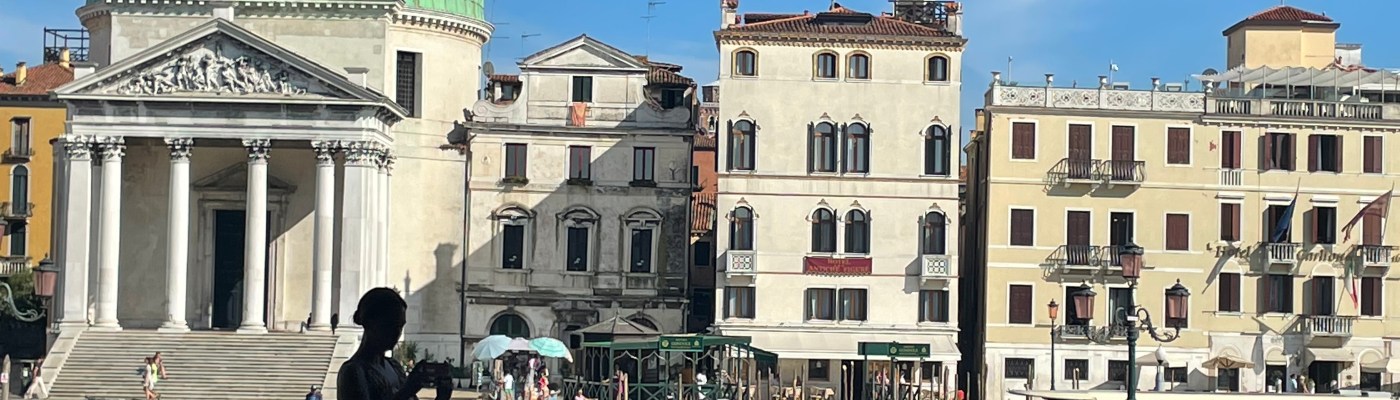
Most visitors to Venice enter through the back door and we were no exception. The famed islands of the lagoon are connected to the Italian mainland by a single hard-working causeway responsible for every car, train, bus and bus-like tram that reaches the heart of the city. Before industrialization, before modernity, travelers were more likely to arrive by boat, winding into the lagoon past the Lido before being greeted by the campanile of Piazza San Marco and San Giorgio Maggiore waiting like sentries at the entrance to the winding Grand Canal. All proper nouns and the romance of the boat idea aside, it was the train that deposited us at the other end of the canal. Even coming in through the back door, we were greeted by the eruption of pastel hued buildings and churches, fronted by the ceaseless back and forth of activity on the canal itself. For all its renown and hyper-touristed reputation, Venice still made a strong first impression.

This was my first visit to Venice. While I’d been in the area on past trips, the reputation of the city held me back for years. Too touristy, not a working city anymore but just a commodified product, the great tourist destination of the Romantic era’s Grand Tour, a city so self-referential as to earn the marketing gold star of a themed Vegas casino, even famously sinking under its own weight. The stereotypes exist for a reason – they’re true. Venice is a place you’ve seen before, in movies, on TV, or a postcard. The vaporetto, the water-based bus serving as public transport, was an hour-long wait crowded with other bag-toting tourists. San Marco and the Doge’s Palace frame the piazza, full of souvenir vendors and people actually trying to get pigeons with oddly-numbered toes to land on them. The Rialto Bridge and market, a package deal owing to their proximity, are crowded with selfie seekers. The narrow streets and lanes are clogged with people looking for…well, looking. The intensity of the sightseeing industry is amplified by the smallness of the city, which can be crossed in the span of a few hours on foot. Gondoliers push overpriced rides, though in the late July tourism peak, they don’t need to try too hard.

Still, for all the camera-toting hordes and the ice cream for breakfast attitude that seems to support a fair share of the local economy, Venice remains beguiling. Sure you’ve seen it before, somewhere. That doesn’t change the effect of being on the narrow streets, of tucking into a bookshop or (a good) restaurant. The way the canals wind through the city, how water is everywhere. Tilting campaniles peering over squares from a distance, adding to the sense of faded grandeur. A great perk is that no cars litter the streets, their nearest refuge being a parking garage at the end of the causeway. Even bikes and scooters are absent. There are too many bridges, too many stairs for them and besides, where would you store them? It is truly a walking city, though supplemented with boats, and a living rebuttal to anyone saying that cities are loud. The effect intoxicates. Ultimately Venice is so unique in its history and setting that few other places can be compared – literally a city without peer.
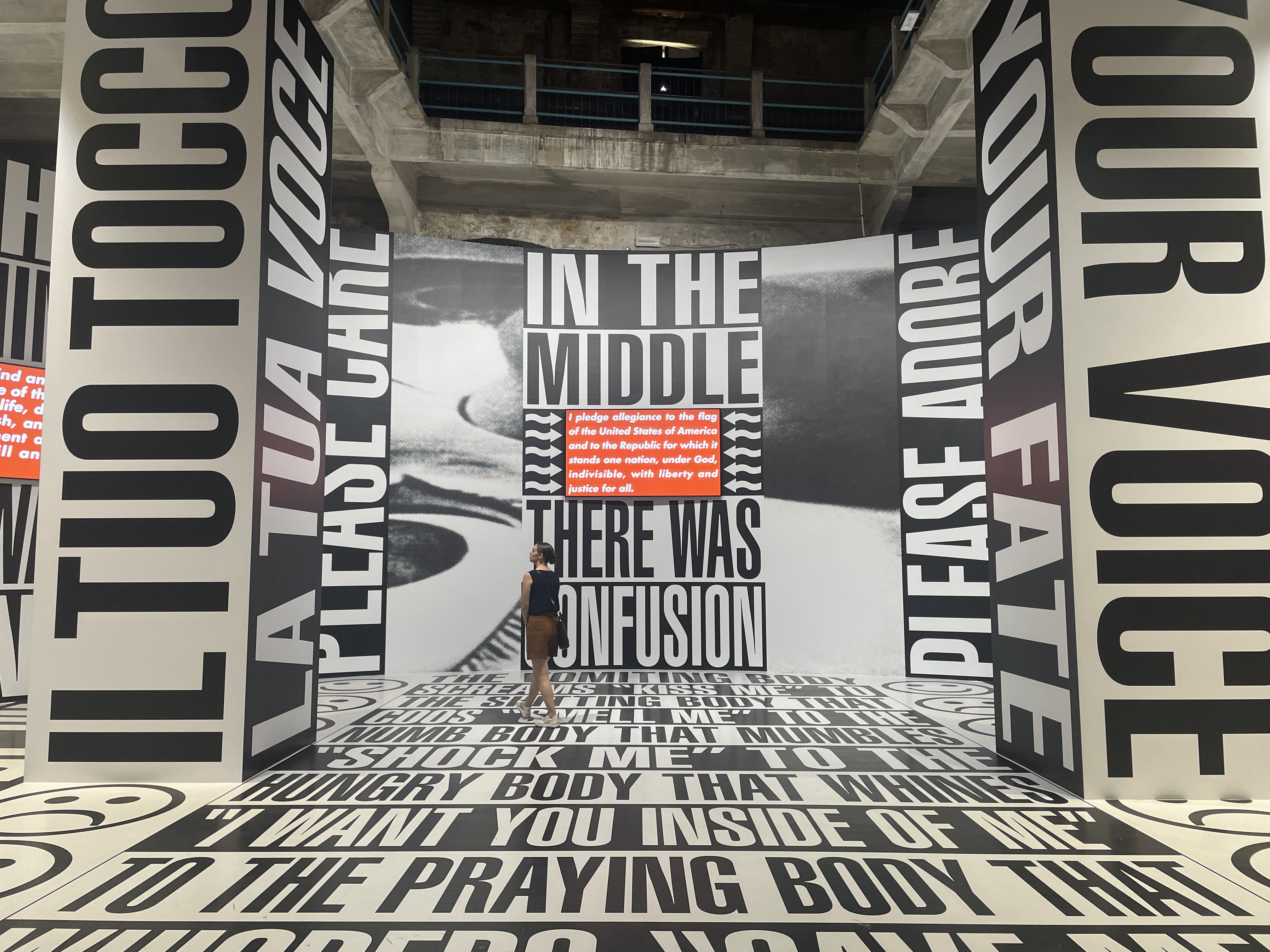
We did our part to look at the main tourist sites, but the focus of our interlude in the city was the arts. Venice has played host to the Biennale since 1895, an annual art show on a massive scale featuring artists and exhibitions from across Europe and farther afield. The main hall is set up in the Arsenale, a large basin that once served as the shipyard of the Republic, a maritime trading power which dominated the Adriatic Sea and other areas of the Mediterranean as the city-state’s fortunes waxed and waned over centuries. Today the tools are put away and the sheds shelter massive installations. These vary dramatically by artist and country. Malta’s was a mesmerizing deconstruction of a musical piece in a darkened room focusing on sequencing liquid metal drops into pools. Next door, Albania was a plethora of humorous and ribald ceramics. The Italy hall was a commentary on post-industrialization and the nature of work, a fitting piece in Venice. We wandered the adjacent Giardini as well, with more national halls including Vancouver’s own Stan Douglas in the Canada Pavilion.
Our other day in town was similarly dominated by the arts. The morning began with a visit to Peggy Guggenheim’s collection, housed in the heiress’ former home fronting the Grand Canal. As a collector, she seems to have had an uncanny eye for works and artists that would stand the test of time, with more notables on display than can be properly named – Jackson Pollock, Max Ernst, Fernand Leger and Leonora Carrington among them. This visit was followed by a short walk to the Gallerie dell’Accademia, yet another massive architectural masterpiece housing Venetian works running from the 13th to 18th centuries. My newfound appreciation for Renaissance art (courtesy of Milan’s Pinacoteca di Brera) was successfully put to the test here. If you see a lion in mourning, it’s St. Jerome. The fellow looking away from Jesus in the last supper? Judas. Among all this, the works of Tintoretto seemed most dramatic to me. A ground floor exhibition featured Anish Kapoor, best known perhaps for the ‘Bean’ in countless Chicago selfies. An entire room was dedicated to his trademarked ‘vantablack’, supposedly one of the least reflective colours in existence. His work uses it to remarkable effect, a treat of visual illusions and trickery that pleasantly surprised me and occupied us for some time.
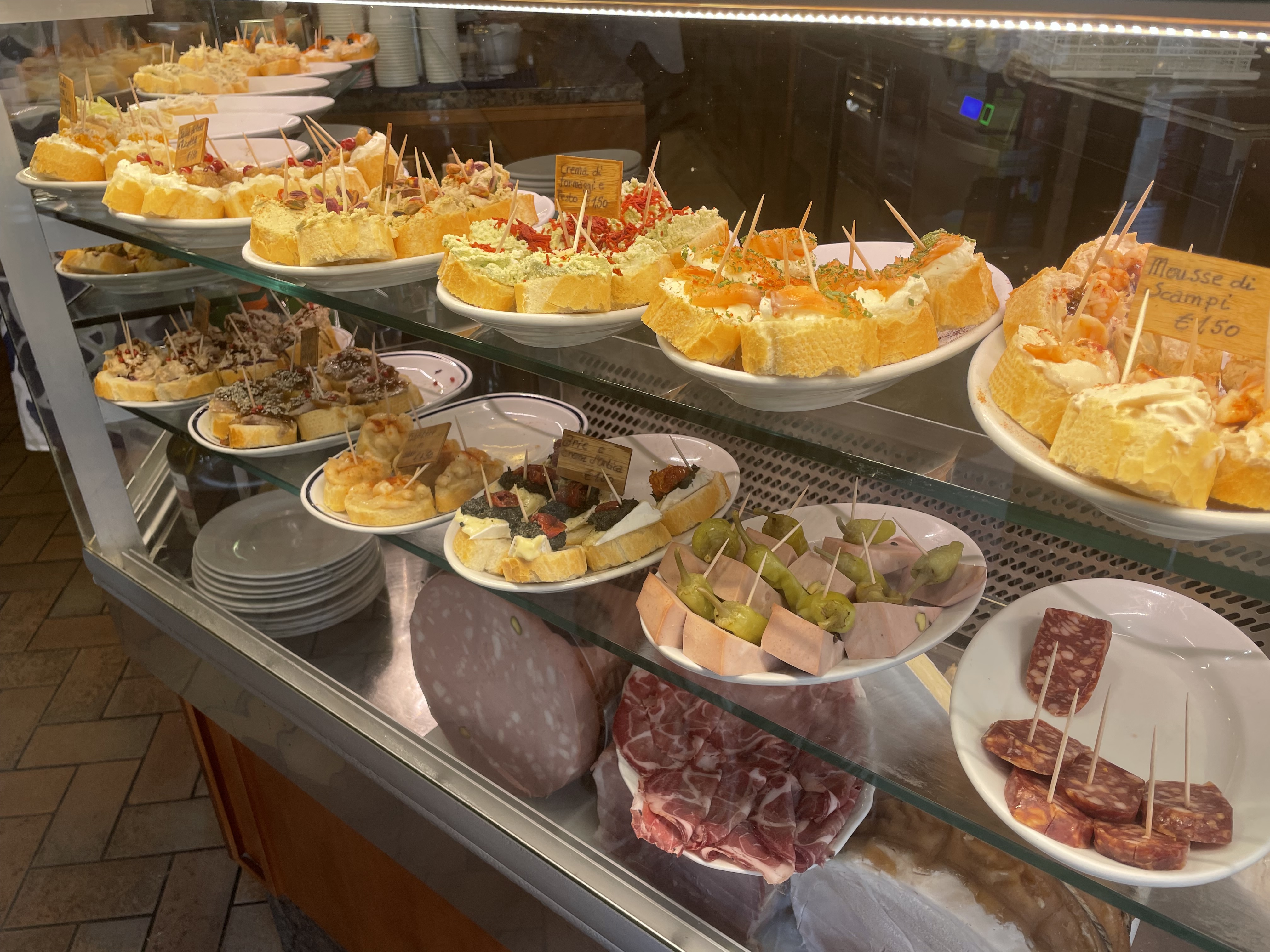
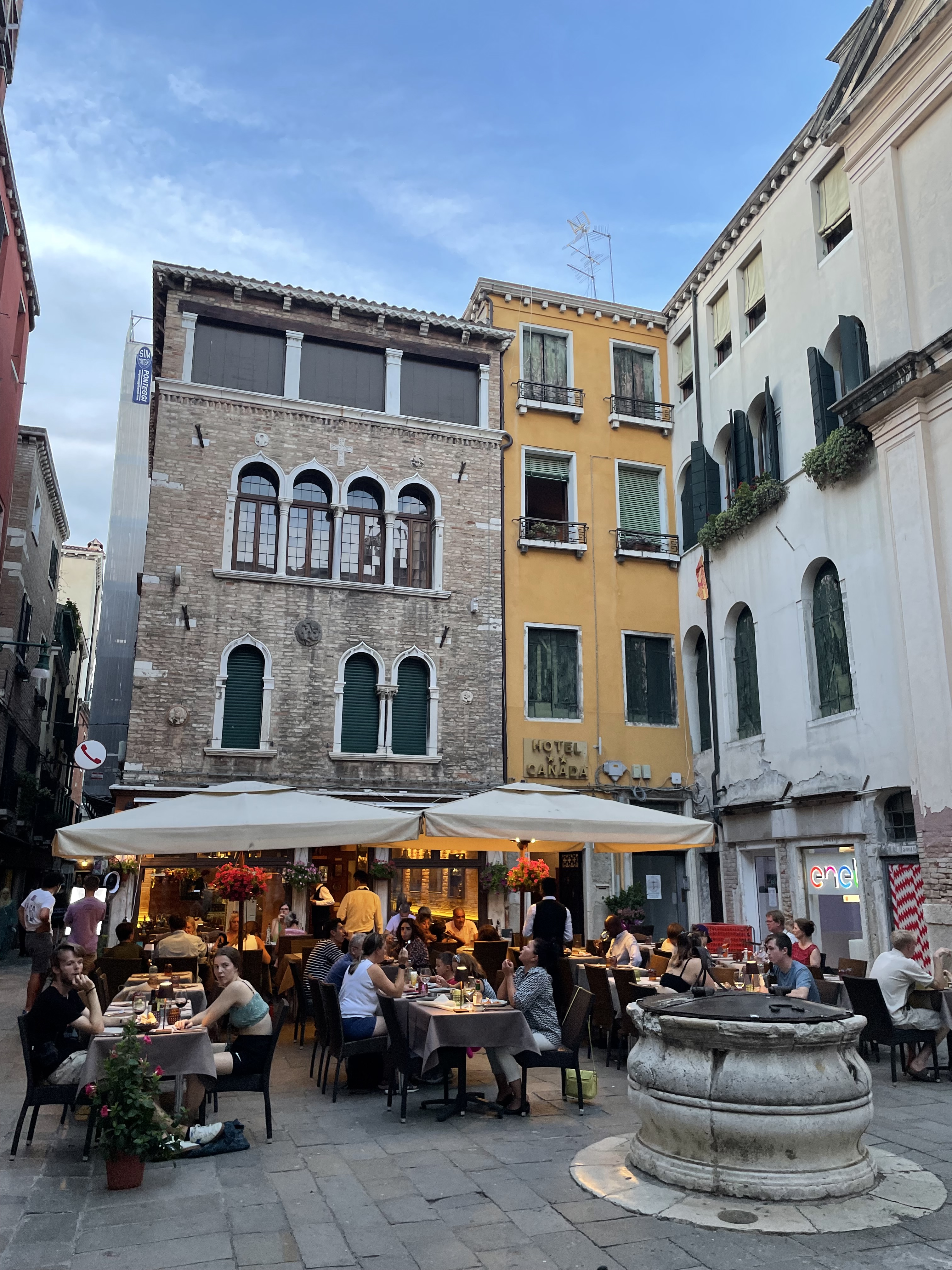
My newfound appreciation of Tintoretto was a case study of Venice on the whole, a place where putting in some effort and doing some of the work can be richly rewarded. It is easy and usually quite enjoyable to grab the first table at a cafe, settle in with a spritz (aperol or campari, depending on the mood) and people watch while waiting for a panini or pizza to arrive. The food, while not spectacular, is solid and this worked fine for lazy meals where we just needed a break. One of our best meals of the trip however was at a small osteria, tucked down the back alleys at the edge of well-travelled San Marco. This was a tip from a friend who had been and it met with the rule of thumb an Italian friend gave us earlier about picking restaurants: look for places with no pictures and no English on the menus, which turned out to be a time-consuming challenge. Nested in at our table, we whet our appetite with a burrata starter before splitting off to our separate plates of a clam and mussels linguine for Hannah and a gnocchi ragu for me. Absolutely heavenly, and all the better in the boisterous, intimate wood-paneled dining room. We left after closing time, with the owner treating us to a limoncello shot as we paid our bill. This hit was followed the next day by more culinary good fortune, a chance encounter with a lunch time taverna, similarly wood-paneled but chock a block with wine bottles and cicchetti, the Venetian answer to tapas. We made our best guesses, pointing at different cicchetti from the cabinet before enjoying them with a glass of white wine. Sometimes its better to be lucky than good, I thought as I munched on my last one, a creamy gorgonzola topped with a walnut.
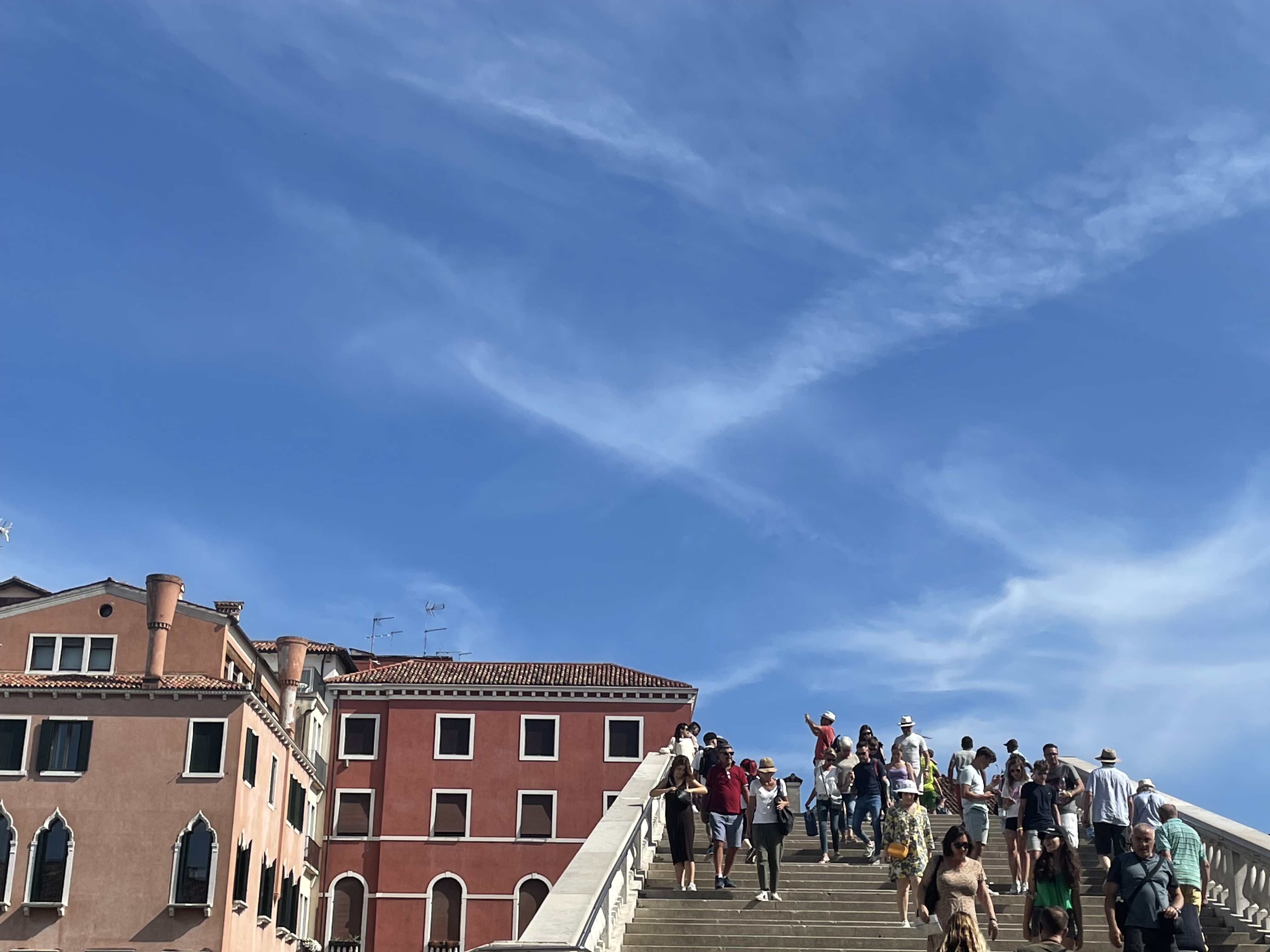
Our stay in Venice was relatively brief, the shortest of our stopovers in Italy. I was hesitant to commit too much time to a place I’d heard so much about and feared that I would either love or, more likely, hate it. Like much of life though, Venice isn’t that simple. It was the claustrophobic cauldron of tchotchkes and basic food, flag-led tour groups marching between postcard scenes. And it was a top-notch art and culture destination, with some of the best meals we’d had. The combination of its small size, remote setting, and hassle to get to make it a truly immersive visit. There are moments while walking along the water’s edge where the outer islands come into view, seemingly calling out to be explored. Really it was enigmatic, and more than anything this exceeded my expectations, because it is wholly unique and because behind the facades lie myriad layers of history that, with good luck and some time, can be peeled back. Venice rewarded that effort and love it or hate it, I want to return to someday.
 Zak Abroad