With our only alternative being to flag down the next errant late-night bus, Hannah and I pulled out our phones, turned on the flashlights, and waded into the darkness. Within a few minutes the gatehouse looked small; in a few more, it was gone entirely, obscured either by a curve in the road or the brush. Around us, the jungle was alive with sounds, hot, humid, damp. The phones cast a pitiful (though welcome!) halo of light around us, no more than a few meters though, with everything else swallowed by the unending darkness. We could hear the sounds of water, of insects and animals, all invisible save for a rather long centipede I spied and did not mention to Hannah. We walked tensely through this heavy night, and I was hoping that it wouldn’t take too long before the damn lodge appeared.

We did, in the end, make it. The crew, almost entirely seeming to be university students on a summer job, were shutting down the dinner platter, and the most empathetic of the bunch, with great English, held them off so we could eat and gave us proper directions to our cabin. We made it, showered, and sank under the mosquito netting. Morning found the trail of ants in the bathroom and we agreed that we were good here. Back to the road, back to the cities, this was a wash of a day. Within ten minutes of reaching where we started, we were on a bus bound to Medellin, Colombia’s second city.
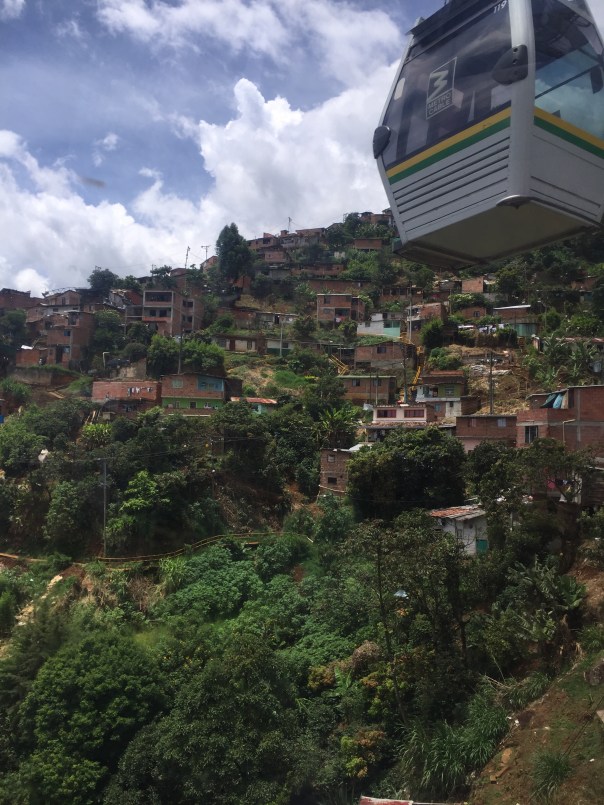
The city is situated in the center of a steep valley, an eruption of red roofs clashing with the dense greenery climbing the slopes and the passing clouds. It is a breathtaking arrival, the city appearing spread out below as the bus begins to wend its way down. It was with relief that we met our AirBnB host, who set us up in our loft downtown and gave us the prescient advice not to stray far or long in the area after dark. While no longer the murder capital of the world, safety is still a going concern.

Safety concerns aside, the hype and the renewal of Medellin is very real. The city core is cleaning up and bustles in the daytime with all manner of activities, centred around the Museo de Antioquia, home of a vast array of works by homegrown artist Fernando Botero, whose rounded, Rubenesque figures strike playfully and at times poignantly at Colombian life. Nearby, past the lively city marketplace, is the Museo Casa de la Memoria. This museum is dedicated to the memories of the violence that wracked the city in the 1990s, when it was the epicentre of the drug trade sparked by another homegrown son, Pablo Escobar. The museum nicely summarizes the broad arc of events while also striking a personal balance, with photos and videos from individuals lost and affected by a period of history that still weighs heavily here.

To nobody’s surprise, I was much delighted by the short but useful Metro system in Medellin, a linear bolt running the valley floor. It has been accentuated by the addition in recent years of cable cars, small gondolas moving in a seemingly endless loop up and down the green hills. The gondolas, or Metrocable, tie in the informal settlements farther up with the more established city below, opening opportunities for work and education to a broader swathe of local society. The views here too are stunning. From above, the city reads almost like geology, with distinct urban stratas discernible as the gondola climbs. At the bottom, buildings are solid, whitewashed and with tiled roofs, a car parked on the paved streets. This changes, becoming less prosperous and more tenuous with the ascent until the last buildings are small wooden shacks at the end of dirt trails, homes for the most recent arrivals. In between, Santo Domingo station provides a bit of public space and activity, a new hub for those nearby.
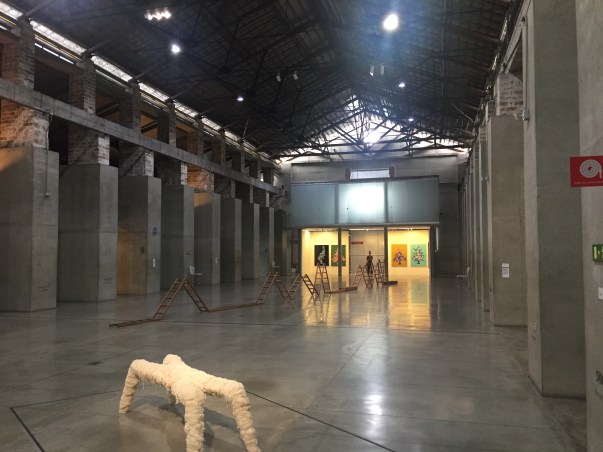
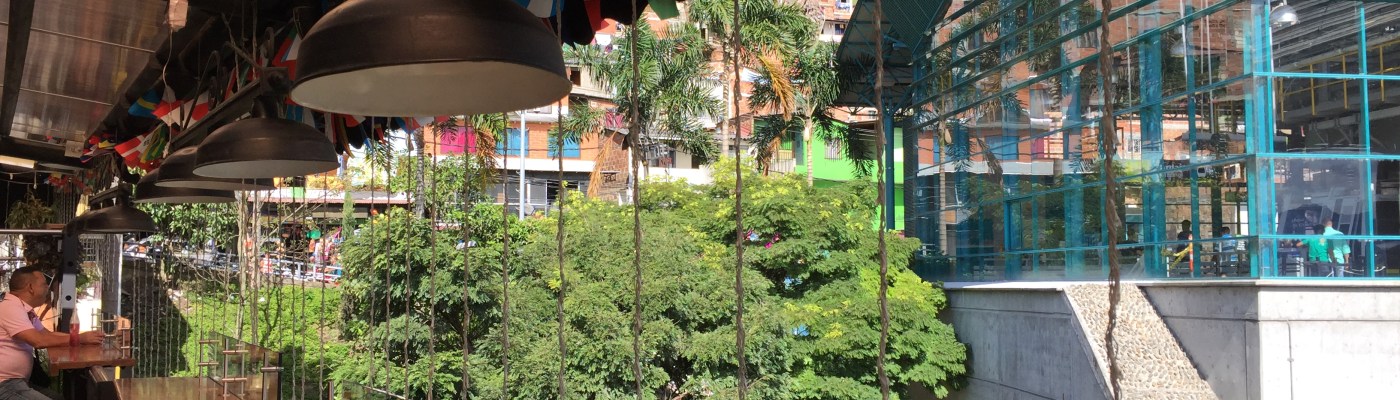
Farther down the valley to the south is the more upscale part of town, how to Parque Lleras and the backpacker hub. Here we met William, a waiter at a restaurant originally from Venezuela, come to Colombia to escape the economic misery inflicted there. By the water is the Mercado del Rio, a repurposed industrial building now turned into (what else) a mall, complete with food courts and a bar serving the ubiquitous global beer brand of Heineken. More interesting selections were to be had at the Museo de Arte Moderno across the road, with a feature exhibit by Jorge Julian Aristizabal. His work runs a gamut that is hard to describe but very much worth seeing, another artist with a contemporary eye to happening in his country. That was a running theme through the building, with other galleries displaying a shared Latin sensibility tending toward political and economic equity and activism to judge from the works spanning Mexico south to Argentina.

Our last night in Medellin was quiet, we stayed in an did Netflix research watching Narcos. Dinner was limited to the cheap restaurants by the bus stations and we doubled down on fried chicken and empanadas, washed down with cold beer to ameliorate the effects on our arteries. The next morning, we found a taxi to the airport, situated back above the valley on the surrounding plateau. We also struck the jackpot with our driver, a middle aged family man who graciously (after confirming our timing) took us on the scenic route, pointing out views and sights along the way. He tolerated our Spanish, slowing down so I could better understand him. Another simple human interaction that was one of the highlights of Medellin.
 Zak Abroad