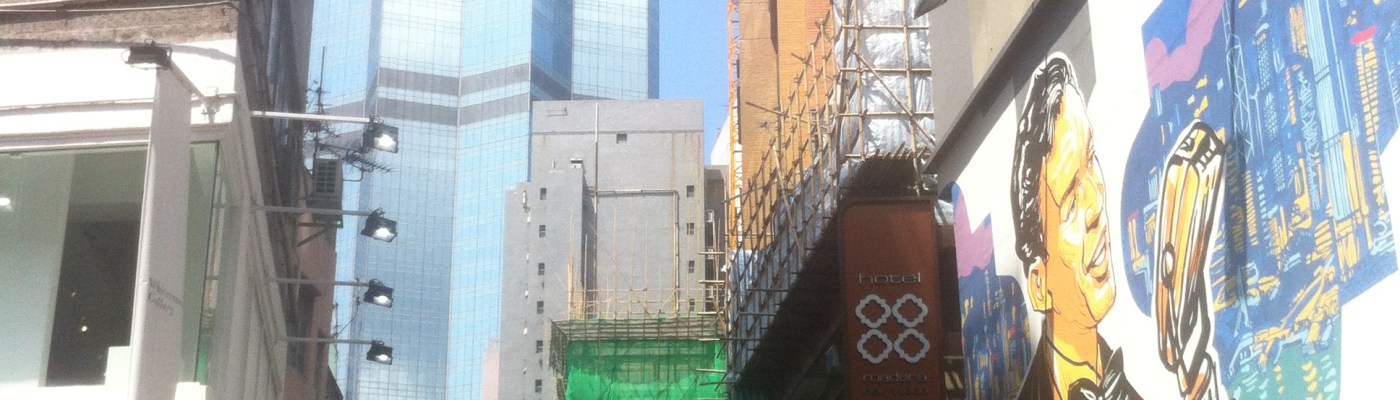
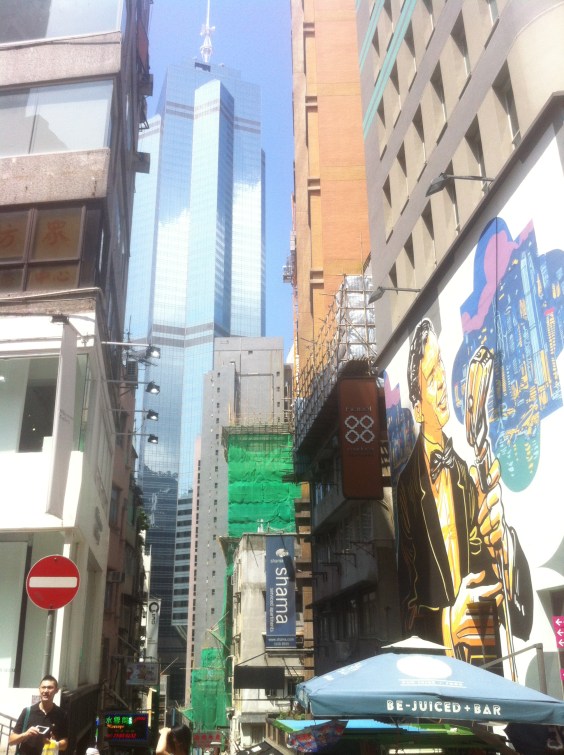
It had been five years since I’d last been to Hong Kong, nexus of east Asia. The city remains the same outwardly, spindly concrete jostling each other to crowd out the sky, hemming in narrow pavements thick with people walking and carrying out their commerce. The same calls for copy watch, copy suit, copy handbag echo down Nathan Road when you pass the mansions, the same elite retail outposts exist a block away. The same busy harbour shuttles people back and forth between the island and Kowloon on the timeless Star Ferry. The heat and humidity still thrive in the early summer, sinking into you and slowing you down, imploring you to pick up that milk tea at the corner store. The difference for me was that, with Hannah, we stayed at a hotel with a window (a real one, looking to the hills, not an airshaft) on the island and not on Kowloon. It was a nice break, a good opportunity to spend the time in no-longer-so-racy Wan Chai. And as always, a good introduction to Asia.
Hong Kong is not a city of museums or grand institutions, but a place best experienced on foot and train. It is a city that functions through its stomach, and Wan Chai supported us with a bevy of eating options. We had tried to research our way through dining, but a peek into the window of a nearly deserted Korean restaurant (Lonely Planet recommended – obvious from the only patrons being a Western couple) led us instead to a small noodle shop, where the eager waiter brought us the English menu and talked us through the process (pick the noodle, pick the toppings, pick the meat, pick the broth) but turned out a great small stop. The same pale green tiles, shining with condensed water from the heat of the city, the heat of the kitchen. We lucked out as well with later stops, hole-in-the-wall Thai, a Japanese restaurant, and tiny French restaurant tucked into the shadow of a hotel near the loading bay. Suffice it to say, we ate well.
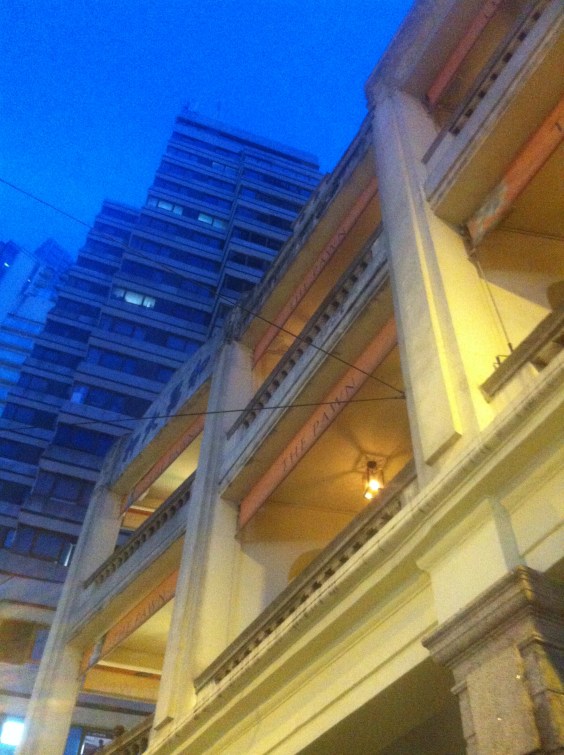
One of the sacrifices Hong Kong has made to 20th century capitalism is the loss of heritage buildings, even the colonial-era stone and brick structures. It was more meaningful then to find the arcaded building home to the Pawn, a cocktail bar, set off the main strip in Wan Chai with a view over the street and the subway stop, a nonstop flow of activity to take in with a cold drink under the lazy ceiling fans. The double-height ceiling spoke to a different era, a different design period, one echoed in the clanging bells of the double-decker trams traversing the island, bedecked with with advertising billboards as they head to Central, to Kennedy, to Causeway Bay.
We wandered the streets of Central, using the escalators to head into the mid-levels to seek out the rare bird of an HK microbrewery. The high costs of land, water, and sheer density make it hard to find such spaces, but we were able to at least enjoy a beer that was neither Tiger nor Tsingtao. Parting ways, Hannah went to view some of the galleries around Central, while took what felt like a long walk in the summertime heat to the City Gallery, an exhibition space dedicated, ostensibly, to city planning for the territory but generally more focused on the mega-infrastructure than the human scale. A nascent environmentalism is present in the more recent displays, but the few fellow tourists and locals passing through tell me that Gallery is not on the cutting edge regardless. I rejoined Hannah at the Gagosian, a global art gallery with a large Hong Kong outpost to take in the latest displays in their 7th floor space. The Gagosian, perhaps appropriately, is housed in the Peddler Building, another heavy stone structure that has managed to survive the heated real estate market of Central.

From Hong Kong we took a ferry to mainland China – to Shenzhen. There we stayed with Nick and were able to catch up with Derek. I took Hannah out on the metro to Buji, my old stomping grounds, much more accessible by train than by bus, where the children pointed at us and shrilled in delight at seeing foreigners. Down my old street, a women casually passed us with a pet monkey in her arms…something I had literally never seen in my time there but one of the great joys (and frustrations) of China is it’s ability to surprise. Shenzhen itself continues to change, to grow, to put a sheen on and round its sharper edges into a more homogenous, prosperous, but somewhat less interesting whole. China has also restricted so many online tools that I have been unable to reconnect with old Chinese friends, social media accounts that have fallen silent to the censor’s searches. Instead we ate (what else?) as Shenzhen is still one of the great cities for Chinese cuisines, a benefit of mass internal migration to the now-maturing boomtown, filling our stomaches on Cantonese changfen, Xinjiang lamian, and any assorted plates crowded with mala, the notorious Sichuanese peppercorn
 Zak Abroad