Fate can play cruel little tricks, sending blessings one way and sorrow another. For my students, this meant 3 days of midterm examinations last week. For me, quite the opposite, as I was sprung free for those same days. Combined with the weekend and the power of night trains, I found myself with 5 consecutive days of no responsibilities. To celebrate this, my roommate Nick and I headed northeast to the rural heartland of China, taking in sites scattered about Jiangxi and Anhui provinces. If you have a map handy, it should have Nanchang on it. Essentially we just worked out from this point to see towns, villages, mountains, and parks. Coming from the booming coastal megacity, the reprieve was welcome.
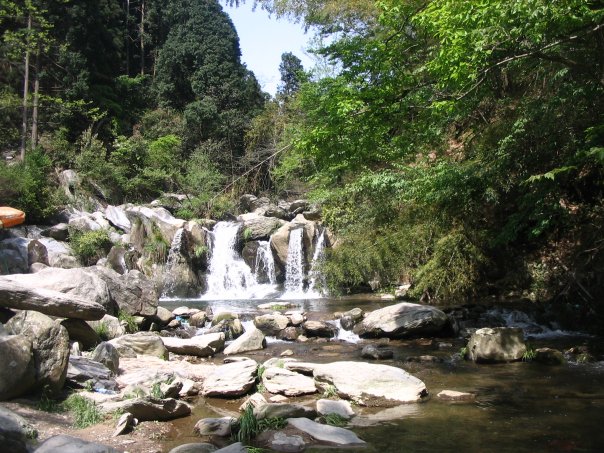
First stop was Lushan, a favorite point for Europeans a century ago in the days of foreign concessions. It is a mountainous area covered in lush greenery and the typical dramatic cliffs dropping off into seas of bamboo that can be found at the famous mountains of China. There were monkeys as well, and we toured around with a perpetually-tardy cab driver who eventually set us off to Jingdezhen, a nondescript city and the porcelain center of China. The guidebook had few kinds words for the town, but its back alleys and the Gu Jie, or ‘ancient street’ was a fantastic display of the communal nature of traditional Chinese life, with doors opened and neighbors filtering in an out, children running up the narrow stone way, and the clinking of mah-jongg tiles in the back rooms filling the night.
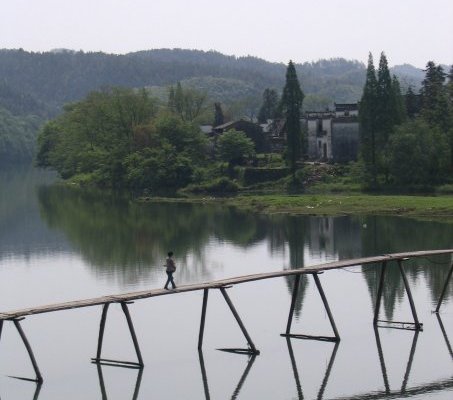
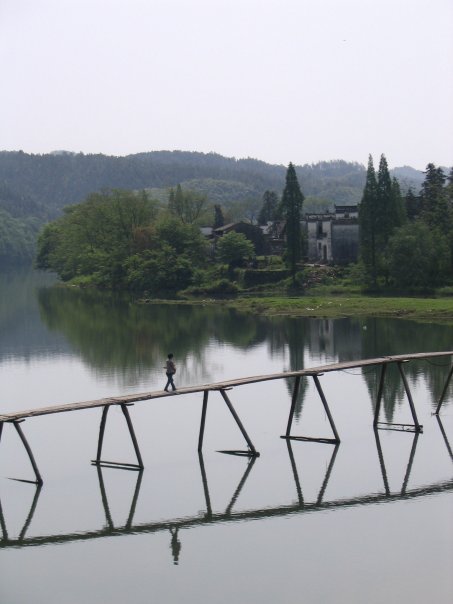
Next day we met some eager moto drivers who told us they could get us to the villages nearby around Wuyuan for free. Some villages have fees, but they insisted we could work around this. Now, we never did pay a fee, but then I am still skeptical we saw the ‘real villages’ and may have only seen villages in the area. Regardless it made for a pleasant half day of the wind in my hair and wandering around old streets and across a narrow wooden bridge through the countryside. In the spring the rice paddies are being plowed and resown and the tea plantations are a sea of vibrant greens. And clear air! Shenzhen, you do not have enough of this! That night we made our way to Tangkou, at the foot of the famed (in China) Huangshan mountain, our target for the next day.
As Friday broke under a wash of rain, my doubts crept up. The entry fee, well over 20 dollars, combined with the poor weather, was enough to dissuade me but not Nick. Thus that morning we parted ways as he began to ascend while I took the bus to Tunxi, the nearest city where we would meet up later. For the day I took my time exploring, ducking down alleyways and exploring streets at my fancy. I found a couple who had a stall along a restaurant row and sat and ate, talking with them a little and finally learning the Chinese words for ‘spoon’ and ‘different’. They had spent time living in Shenzhen, so it was nice to find other ‘locals’ who knew of my town.

One of my favorite days was to follow. Having successfully found Nick at our hostel, we set out to Shexian, the center of Huizhou culture of merchants, some hour or two away, with few expectations to be had based on the short blurb in Lonely Planet. Shexian, it turns out, is fantastic. It has an extensive old city center packed with winding alleyways and storefronts, street life and activity out for the world to see. We were given a guided tour after purchasing our ‘student’ tickets with a wink from a nice young lady and got lunch afterwards. Here a playful puppy clattered about the floor while I watched the Blazers blow a game in Houston on the TV. The NBA playoffs are an exciting thing here, and the fact that my beloved “Kaituozhe” are playing the Rockets is not lost on my students. It is a nice common ground to have with them.

Outside of Shexian a few kilometers is a former storehouse town set along the river called Yuling. Like Shexian, it is a winding labyrinth of alleys and walkways between beautiful white-washed old buildings sprawled out along the river bank. Behind all this are the farm plots and then the forested hills that punctuate the sky. It has the mythic air of China that is imagined and evoked in film and popular displays of the country, and it is nice to commune with this and remember that for the size and number of Chinese cities, there are still these places all over the country as well.

We left that night on a night train with ‘hard seats’ in a car packed with Army soldiers making for a long night of fitful sleeps. The last day was an excursion back to Jiangxi province to visit Jinggangshan, a popular point for domestic tourism as it is the starting point for Mao Zedong’s Long March. I’ll spare details but to say that the contrasts between the modern capitalist fracas and the humble idealistic roots are…glaring. The costs were glaring as well, hardly in line with opening such a monument to the proletariat. I mostly wandered around the town arguing with the hawkers about the high prices they were trying to charge me for buying things like food and ice cream.
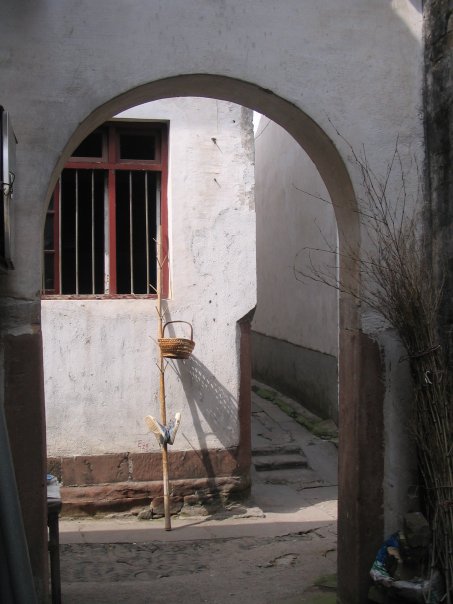
Ironically, perhaps the nicest discovery was on our way out to catch the night train into Shenzhen. We hopped the local bus to the train station, a massive monstrosity more on scale with a regional airport than a train station that sees four arrivals a day. It was clearly built in these fields with the idea of expanding tourism, and this is further evinced by the massive new city being constructed within sight. Lost amid this is the small village right outside the train station, a sprawling layout of old traditional masonry homes and farm buildings. We went into it on a lark, with time to kill, and the people were curious about our presence and constant photo-taking.
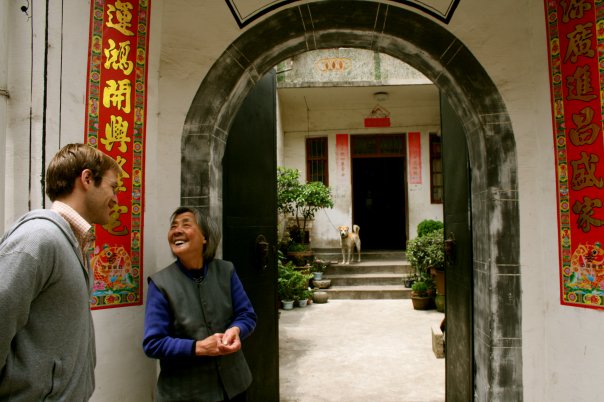
They were talkative and Nick did a good job as the translator, despite their hard rural accents. The sun started to get back past the western hills and it looked as a scene pulled from Pearl Buck’s “The Good Earth”, an account of early 20th century life in rural China. The reflection beat against the water of the rice paddies while a man guided his water buffalo, pregnant, we learned, away from the fields. Nearby new tiled-clad midrises were being put up, and it was another instance of China’s drive for development crushing over the charming parts of its past. We were able to catch a much better amount of sleep on the train back to Shenzhen and after a long rush across the city in the morning, made it back in time for our afternoon classes.
 Zak Abroad
Great narrative, Zak. Thanks for taking me on your journey. Hope you enjoyed the Buck book, I was going to send it to you, but sounds like there is no need to now.
Just checked out the pics. Oh, the places you’ve gone and the things you have seen! The lover’s locks reminded me of the Ponte Vecchio in Florence.