We left late on a Friday night, freed from school obligations by the impending midterms week which arrived in conjunction with the May 1 holiday, and instead came into Kuala Lumpur late, where we whiled away our 8 hour layover at the food court cafeteria under some fluorescent lighting. After this seeming eternity we boarded the flight to Vientiane, arriving into the airport early in the morning and actually having to seek out a taxi driver for once…a very bizarre thing for Asia.
For a capital, Vientiane is both small and unassuming, a gridwork of streets interspersed with alleyways and Buddhist wats (monasteries) that seems to exist much as the long, brown Mekong that borders its southern flank, moving slowly and steadily without any particular rush or hurry. For tourists, the place is a bit deficient on must-sees but instead we meandered the small blocks amidst the low-rise buildings and enjoyed the relaxed, casual atmosphere, a most welcome respite from the frenzy of Shenzhen (and our classrooms). The city is easy to manage on foot and the food is quite good, with ample supply of Lao, Asian and Western cuisine catering to the foreigners.
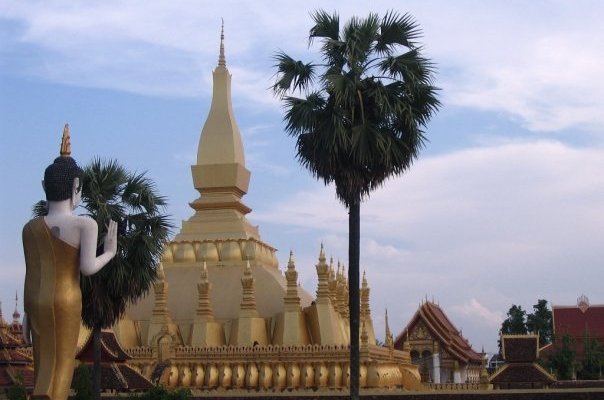
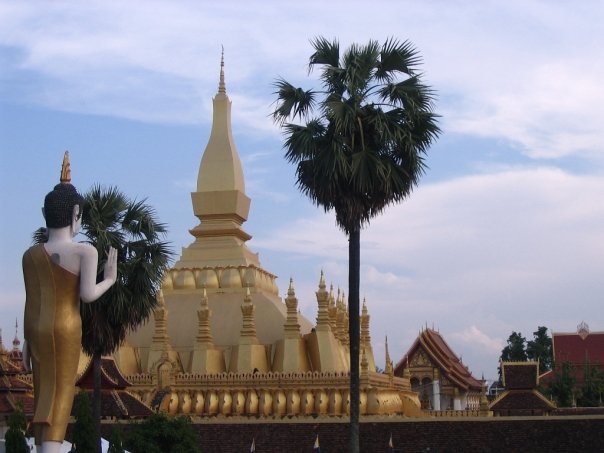
Our second day we spent exploring the sites, renting undersized bicycles to do so as we ventured out to the Lao national monument, the gold leafed Pha That Luang, a large Buddhist stupa that dominates its surroundings and is pretty damn cool just to see. Along the way biking down the largest street in the city (very little traffic) we passed an old carnival where Andrew and I were able to propel Anna about halfway up a defunct ferris wheel before gravity and rust conspired against us. We also passed the Patuxai, a Lao-equivalent of Paris’ Arc de Triomphe, which we had visited the first day and garnered a great view of the city from above. After some customary visits to a few of the city’s other wats, we were on our way to the bus station, awaiting our overnight trip to Luang Prabang.
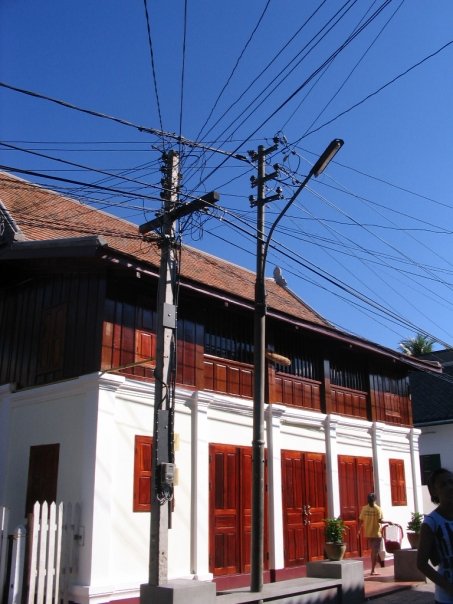
Luang Prabang is probably the tourist center of Laos, a city of about 30,000 situated primarily on a peninsula between the Mekong and tributary river. It was a former capital and colonial center and the inner city bears of evidence both of past Lao rulers as well as ample evidence of the French presence in the former colony. For being awash in tourists, the town manages to maintain a pleasant, genuine atmosphere that makes it exceedingly simple to enjoy. For all the foreigners on the main strip, it is easy to get off the path and explore side alleys awash in greenery and well-kept older buildings. Numerous wats studded the cityscape, and our ride in from the bus station on arrival was early enough to catch the daily alms giving ceremony in which the monks take to the streets in their saffron robes and accept gifts of food and such from townsfolk and tourists alike. In nominally atheist China and particularly capitalist Shenzhen, we never see these things.
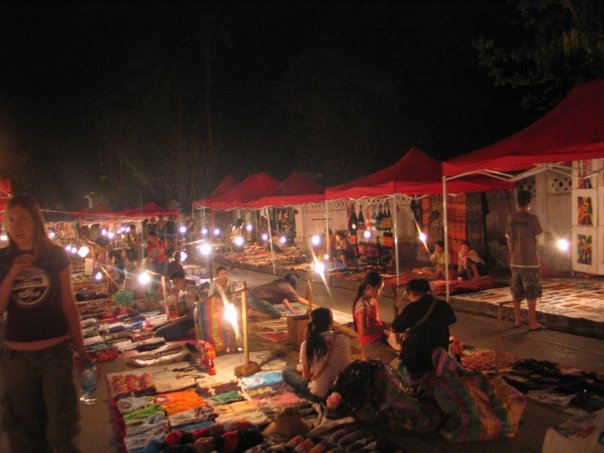
Our first bit of time was spent enjoying the town, getting to know the layout, and sitting along the banks of the Mekong watching the sun descend behind the verdent slopes of the far bank. We had arranged for a 2-day trek into the mountains where we were to visit with Hmong and Khmu villages and spend a good number of hours just crashing through the jungle. Luang Prabang served as a wonderful rest and counterpoint to what was to come, and the excitement, activity and noise of the night market and food stalls in town was a sharp contrast to our little excursion into the jungle, upon which I will elaborate in the next installment.
 Zak Abroad